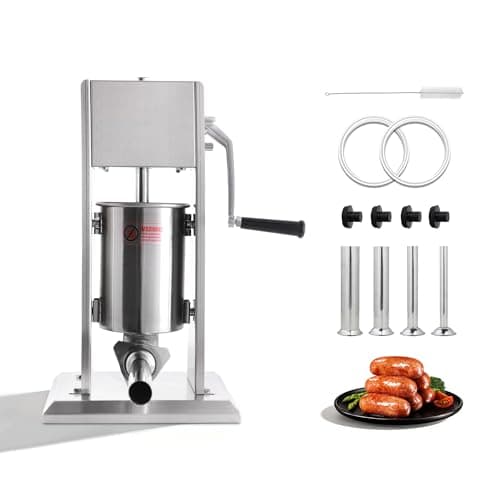
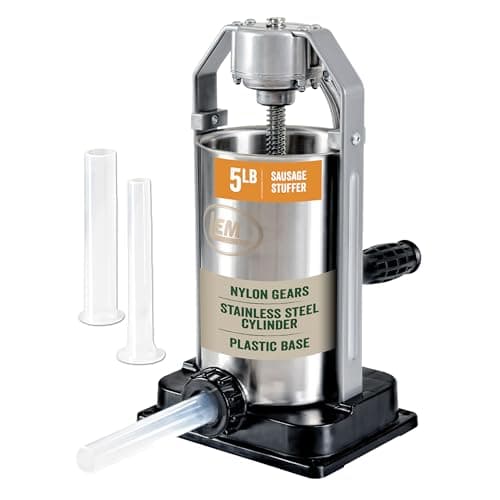
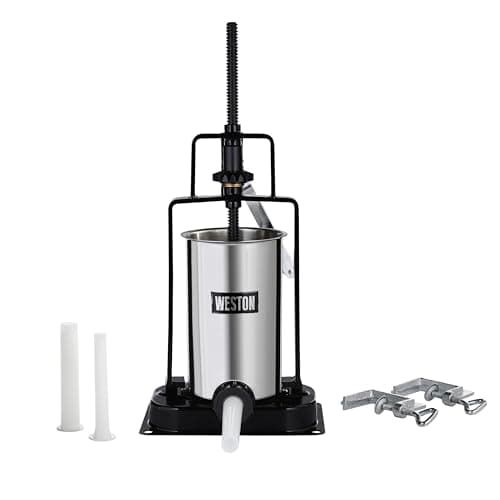
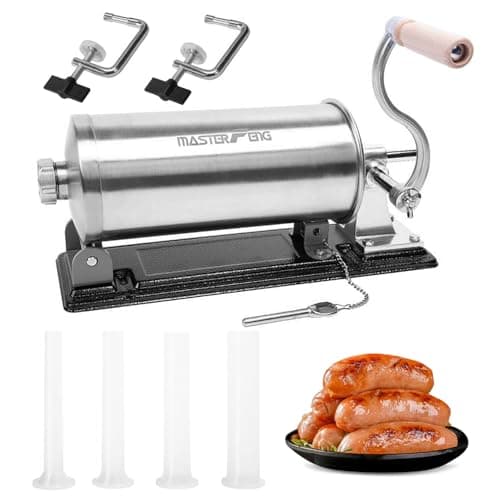
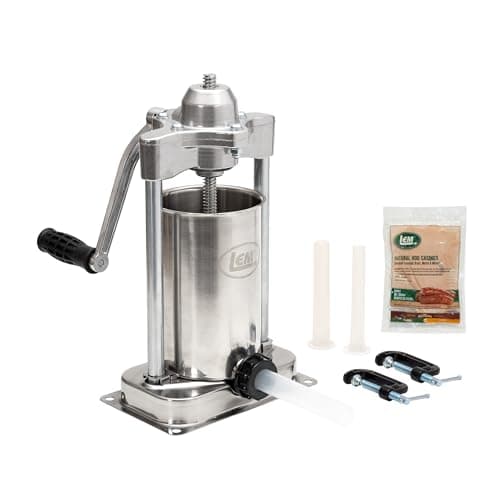
For a first sausage stuffer, buy the LEM MightyBite 5 lb vertical with hog casings. It has the things that matter on a first batch and rarely appear together at this size: carbon steel gears rather than nylon, a removable cylinder, a piston with an air release valve, a two-year warranty, and a bag of natural hog casings in the box — so the only things you still need are meat and seasoning. If you want to spend less, the Hakka 7 lb gives you two speeds and four stainless tubes and asks you to accept that Hakka will not tell you what the gears are made of.
The four checks before you buy
A stuffer is a simple machine: a cylinder, a piston and a gear train. Four things separate a good first one from a frustrating one.
- Gear material. Steel or carbon steel gears last; nylon gears are the part that strips under a stiff mix. Very few makers publish it at this size — LEM and Weston do, Hakka and Master Feng do not.
- An air release valve in the piston. Without one, air trapped above the meat has nowhere to go and you get air pockets in the links. Every machine on this page has one, which is why every machine on this page is here.
- Tube sizes, matched to what you want to make. This is the check beginners skip and regret. See the next section.
- Whether clamps are included. A stuffer that is not fixed down walks across the bench while you crank. LEM's beginner model (1899) does not include mounting hardware; the Master Feng includes two G-clamps.
The snack-stick trap
Most people making venison sausage for the first time want two things: fresh links in hog casing, and snack sticks. Those are very different jobs for a stuffer, and a beginner machine will usually do one of them.
LEM says so plainly about its own beginner model: the 5 lb stuffer for beginners (1899) is not intended for snack sticks. That is on LEM's own spec sheet, and we rate the company for publishing it. The reason is mechanical — forcing a stiff mix through a 1/2 in or narrower tube takes far more pressure than filling a 32-35 mm hog casing, and nylon gears are where that pressure goes.
| What you want to make | Casing | Smallest tube you need | Which of these five will do it |
|---|
| Fresh links, brats | 32-35 mm natural hog | About 20 mm | All five |
| Summer sausage | 2.5 in fibrous | About 38-40 mm | Hakka (38 mm) comfortably; others are tight |
| Snack sticks | 19-21 mm collagen | About 10-13 mm | None of them well. Hakka's smallest is 16 mm; LEM says not to |
If snack sticks are the whole point of buying a stuffer, do not start here. Our snack stick stuffers page covers the machines and tubes that genuinely handle a 3/8 in tube, and it is a different shopping list.
The five, side by side
| Spec | LEM MightyBite 5 (1764) | Hakka 7 lb SV-3 | LEM 5 lb beginner (1899) | Weston 5 lb | Master Feng 6 lb |
|---|
| Orientation | Vertical | Vertical, tiltable | Vertical | Vertical | Horizontal |
| Capacity | 5 lb | 7 lb (3 L) | 5 lb | 5 lb | 6 lb |
| Gears | Carbon steel, covered gearbox | Not published | Reinforced nylon | Steel, per Weston | Not published |
| Speeds | Single | Two | Single | Single | Not published |
| Air release valve | Yes | Yes | Yes | Yes | Yes |
| Tubes | Plastic; sizes not listed | 4 stainless: 16, 22, 32, 38 mm | 3 plastic: 11/16, 7/8, 1 in | Per Weston's listing | 4 plastic: 15, 19, 22, 25 mm |
| Clamps included | Not stated | Not stated | No | Not stated | Yes, two G-clamps |
| Casings included | Yes, 6.1 oz hog casings | No | No | No | No |
| Warranty | 2 years | Not on the listing | 1 year | Per Weston | Not published |
Two columns tell the story. The LEM 1764 is the only machine with steel gears, a two-year warranty and casings in the box. The Hakka is the only one with two speeds and four stainless tubes, for less money, with the gear material unstated.
Vertical or horizontal, for a first stuffer
Vertical, almost always. A vertical stuffer uses the weight of the mix to help fill the cylinder, takes less bench width, and puts the tube at a height where you can support the casing with your free hand. A horizontal stuffer is cheaper and clamps to a table edge, which is a real advantage if you have no dedicated bench — but you are working across yourself rather than in front of yourself.
The exception is budget: the Master Feng horizontal is the cheapest way onto this page by a distance, and for two or three batches a year it works. Our vertical vs horizontal comparison goes through the trade-offs properly.
What else you need for a first batch
The stuffer is one item on a list, and buying it alone is the most common way a first batch stalls:
- A grinder. Sausage starts as ground meat. If you do not have one, see grinders for deer — or a grinder-stuffer combo, though a combo stuffs less well than any machine on this page.
- Casings. Only the LEM 1764 includes them. Natural hog casings need rinsing, soaking and refrigeration; collagen casings do not.
- Fat. Venison is too lean to make sausage on its own. Our fat ratio guide has the proportions.
- A thermometer, if you are making anything cooked or cured. Summer sausage and snack sticks hinge on internal temperature, not time. See thermometers.
- Cure, only if the recipe calls for it. Fresh links need none. Anything cured or smoked low does — and the amount is not a matter of taste. Read our curing salt guide before you buy any.
A seasoning-and-cure kit is a reasonable shortcut for batch one, because it takes the measuring decision out of your hands entirely. Our summer sausage page covers the kits.
Do not buy bigger than 5 lb yet
It is tempting to buy the 11 or 15 lb stuffer on the theory that you will grow into it. For a first machine that is usually the wrong call, because a stuffer has to be filled before it is useful. A 15 lb cylinder wants 15 lb of mixed, seasoned, chilled sausage meat ready at once. At the Ohio DNR average of 52.19 lb of venison per deer, a first-timer making sausage from part of one deer is working with 5 to 10 lb of mix — which is one comfortable load in a 5 lb or 7 lb cylinder and an awkward half-load in a big one.
Buy bigger when the batch size, not the ambition, justifies it. Our full stuffer roundup covers the 11 lb, 15 lb and motorised machines for when that day comes.
How we ranked these
On the stuffer rubric used across this site, then weighted toward the things that go wrong on a first batch: published gear material, an air release valve, tube sizes that match the sausage a beginner actually wants, and what is in the box. We have not bench-tested any of them. Every figure comes from the maker's spec sheet where it publishes one and the maker-supplied listing copy otherwise, and each product card links its sources.
Where a maker does not publish a gear material or a warranty term, we have said “not published” rather than assuming the worst or the best. Two of these five decline to state their gears, and for a machine whose gears are the part that fails, that is worth knowing before you buy rather than after.
One thing to notice in the scores: the Hakka outscores our top pick on the general stuffer rubric, largely on its two speeds and four stainless tubes. It is second here because a first stuffer with casings in the box and a published gear material removes two ways a first batch goes wrong. That is deliberate and it is how every ranked page on this site works — the order answers the question in the title, and the score is the rubric's separate view of the product as a whole. Both are on the page so you can disagree with us.
How we picked
Units we claim to have bench-tested: none
Plenty of sites say they ground two hundred pounds through every grinder. We didn't, and we say so. What we do instead: read the maker's spec sheet, manual and warranty terms, record the figures that decide whether a machine keeps up with your season (size number, motor rating, rated pounds per minute, capacity, duty cycle, gearing), check parts availability, and score each pick on a published rubric. Then we show the season math — pounds per deer from the Ohio Division of Wildlife's yield study — so you can redo it with your own numbers.
Scores are editorial judgments from that documented research, not lab results. Nobody pays for placement. The rubric and weights are on the How We Pick page.