The Best Sausage Making Kits, and Which Kind You Actually Need
Two completely different products get sold as a sausage kit: a box of seasoning and matched cure, and a box of hardware. Buying the wrong one is the most common first mistake in home sausage.
#ad · Prices come live from Amazon, last checked November 4, 2026; where we have no verified live price we show none. Scores are ours, compiled from published specs, manuals and warranty terms, not bench tests. Tap a row for the full write-up.
Search for a sausage making kit and you get two unrelated products on the same results page. One is a box of seasoning with a matched packet of cure and usually some casings — a recipe, pre-measured, for a stated number of pounds. The other is hardware: a stuffer, sometimes a mixer, no seasoning at all. Both are called kits. Which one you need depends on a single question, and it is not about flavor: do you already own something that can push ground meat into a casing?
Two different things get called a sausage kit
A seasoning kit solves the part of sausage making that is genuinely hard to get right the first time: the cure. It is a sealed packet of spice blend plus a separately sealed packet of curing salt, measured against each other for a stated weight of meat, with a printed sequence. Most of them throw in casings. The whole value is that you are not doing arithmetic with a substance that is toxic at the wrong dose.
A hardware kit solves the mechanical part: a cylinder, a piston, a gear train, and a set of tubes to match casing diameters. It contains no seasoning, no cure and usually no casings. Buying one of these expecting to make summer sausage on Saturday is the classic disappointment.
We rank both on this page because the search intent covers both, and we label every pick so you cannot confuse them. Ranks one through five are seasoning kits. Ranks six and seven are hardware. If you want the full hardware conversation rather than two starter picks, that lives on best sausage stuffers and best sausage stuffers for beginners.
What we judged them on
We have no test kitchen and we will not pretend a batch of summer sausage was made here. What we can do is read what each maker commits to in writing and rank on it. Five criteria, in the order they change your outcome:
Is the cure pre-portioned to the seasoning? This is the only criterion that is a safety matter rather than a convenience one. A kit whose cure packet is matched to its seasoning packet for a stated weight removes the dosing step entirely.
Are the right casings in the box? Not any casings — the ones that match the product. Summer sausage needs 2-1/2 inch fibrous; snack sticks need roughly 21 mm collagen. A kit that includes the wrong size is a kit that needs a second order.
Does the maker print a finish temperature? Some do, some do not, and one of them prints a number we disagree with. Either way, you want to know before you are standing at the smoker.
How many pounds does one box cover, against a realistic batch and against a deer's worth of venison?
What does the maker tell you about fat? Venison is too lean to make sausage on its own. A kit that gives a fat target is doing you a favor.
Price is deliberately not on that list. Every seasoning kit here sits in the same low two-figure bracket, close enough that a few dollars should not decide it; the buttons carry the live price so you can check rather than trust a number we typed. The hardware picks are an order of magnitude more, which is exactly why they are labeled separately.
The cure is the point of a kit
Cured sausage gets a small, measured dose of sodium nitrite. At the right dose it is what keeps botulism out of a sausage that spends hours in the warm, low-oxygen middle of a smoker. At the wrong dose it is a poison. Extension services are blunt about this, and so are we: this is the one step in home sausage where improvising has a real downside. We work through the chemistry, the two cure types and the dose math in the curing salt guide.
Hi Mountain's instructions also tell you not to mix in metal containers or bowls. That is a real constraint rather than a quirk, and it is the sort of thing a printed sheet gives you and a bag of loose seasoning does not.
Casings: what is in the box, and what is not
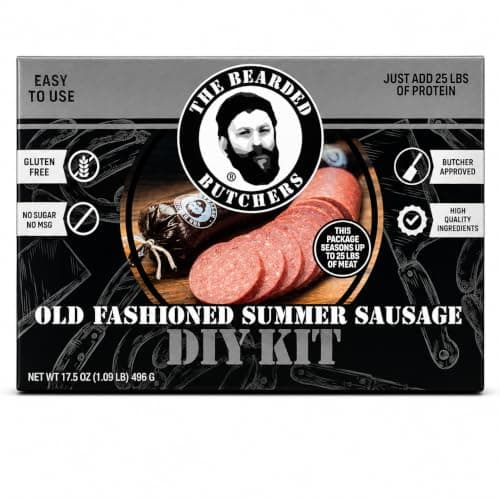
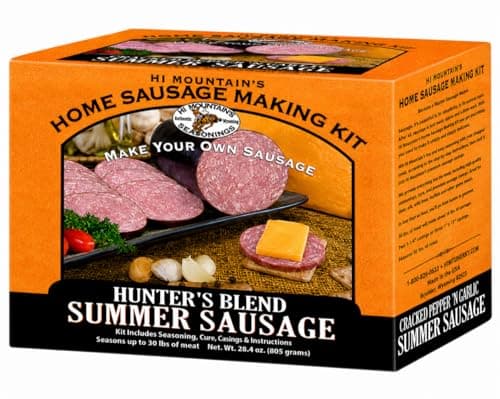
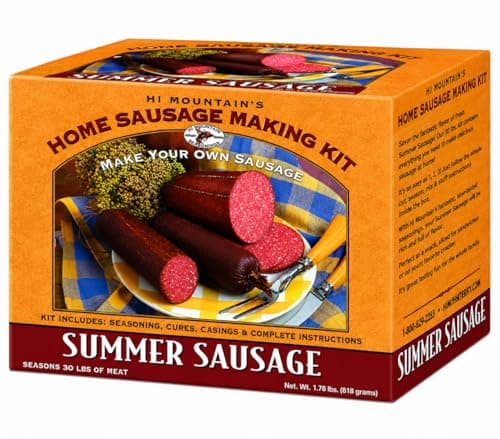
This is where kits separate. Both Hi Mountain summer sausage kits include ten mahogany fibrous casings, 2-1/2 by 20 inches, holding up to 3 lb each. Ten casings at 3 lb is 30 lb of capacity, which matches the seasoning exactly — a kit that actually adds up. Bearded Butchers includes ten 2-1/2 inch fibrous casings for its 25 lb batch, so the same arrangement with a little headroom.
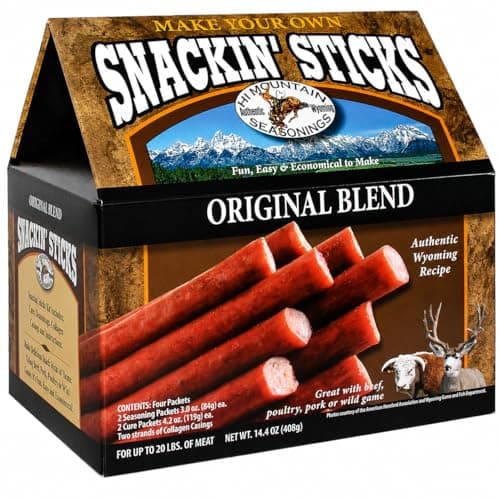
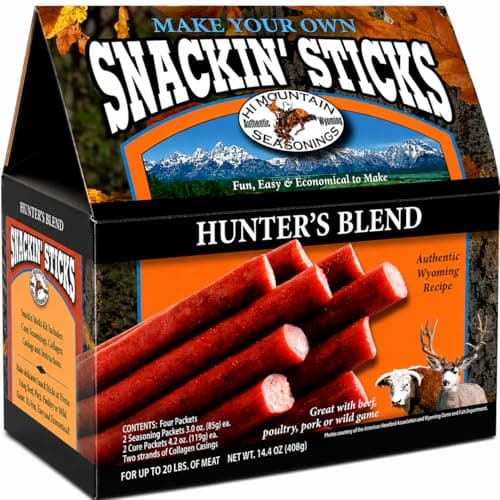
The snack stick kits include a different thing entirely: four strands of 21 mm mahogany collagen casing. That is correct for sticks and useless for summer sausage, and it comes with a hardware requirement most first-time buyers miss. A 21 mm collagen casing needs a stuffing tube of roughly half an inch outside diameter or smaller. Plenty of 5 lb stuffers ship with nothing below 11/16 of an inch — including one of the hardware picks on this page, which is why we ranked it last and said so on its card.
Check your smallest tube before you buy a stick kit, not after. If you are short one, the fix is a cheap dedicated tube rather than a new stuffer; we cover tube and casing matching in best sausage stuffers for snack sticks.
The printed temperature, and the one USDA publishes
Both Hi Mountain summer sausage kits print a finish temperature of 156°F internal. The USDA's safe minimum internal temperature for ground meat of any species is 160°F. Those are not the same number, and we are not going to paper over a four-degree gap in a food-safety figure on a page that recommends the product.
Our position: cook to 160°F. The kit is still the best one here — the pre-portioned cure, the matched casings and the printed procedure are all real advantages — but the thermometer is yours, not the packet's. Four degrees costs you a few extra minutes in the smoker and nothing else. Bearded Butchers prints no finish temperature at all in the listing we cite, which lands in the same place: use 160°F.
That means a kit does not remove the need for a thermometer, and a dial thermometer is not good enough for a four-degree decision. Our picks for the probes we would actually trust at this step are in best thermometers for jerky and sausage.
Match the kit to your batch, not to your freezer
One deer yields about 52 lb of venison at the Ohio DNR average (115 whitetails weighed in the 2017 gun season). Nobody turns all of that into summer sausage; a realistic first batch is 25 lb of finished mix, which at a conventional pork-fat blend is roughly three quarters venison and one quarter pork trim.
Kit
Covers
Casings included
Batches at 25 lb
Finish temperature printed
Hi Mountain Original Summer Sausage
Up to 30 lb
10 fibrous, 2-1/2 x 20 in.
One, with room over
156°F (we use 160°F)
Hi Mountain Hunter's Blend Summer Sausage
Up to 30 lb
10 fibrous, 2-1/2 x 20 in.
One, with room over
156°F (we use 160°F)
Bearded Butchers Old Fashioned Summer Sausage
25 lb
10 fibrous, 2-1/2 in.
Exactly one
Not printed (use 160°F)
Hi Mountain Original Snack Stick
Up to 20 lb
4 strands, 21 mm collagen
Under one
Not printed (use 160°F)
Hi Mountain Hunter's Blend Snack Stick
Up to 20 lb
4 strands, 21 mm collagen
Under one
Not printed (use 160°F)
Figures from each maker's listing, cited on the cards below. Note what the table says about the stick kits: at 20 lb they are smaller than a 25 lb batch, which is correct — snack sticks are slow to stuff and nobody wants their first attempt to be 25 lb long.
When you need the hardware kit instead
If you have a grinder and nothing else, the seasoning kit is the wrong first purchase. A grinder with stuffing tubes fitted is not a stuffer: the auger keeps turning and shearing the mix while you are trying to fill a casing, which smears fat and makes air pockets — true even on the best grinders, as we note in LEM BigBite vs MEAT! Your Maker. We walk through why in sausage stuffer vs grinder attachment.
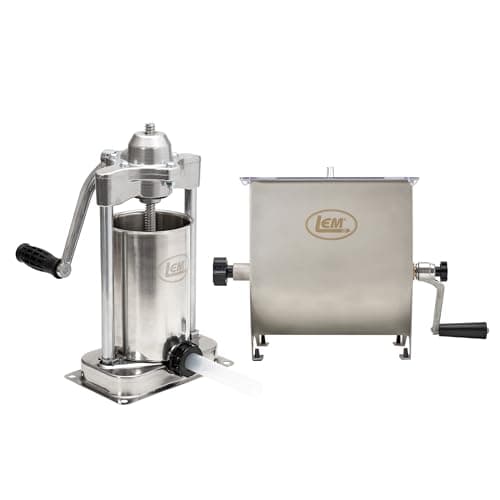
Of the two hardware starters here, the LEM MightyBite 1765 bundle is the one we would buy. It pairs a 5 lb stuffer with carbon steel gears under a gearbox cover and a removable cylinder with LEM's 20 lb manual mixer, and carries a two-year warranty on both pieces. The mixer matters more than it sounds: blending seasoning and cure evenly through 25 lb of cold meat by hand is the step people do badly, and uneven cure distribution is the one error with a safety dimension. Its tubes start at 1/2 inch OD, which is also the only tube size on this page that will take a 21 mm stick casing.
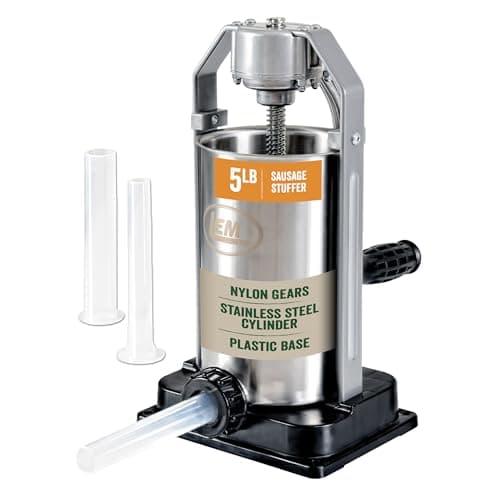
The LEM 1899 is cheaper and honest about its limits. LEM states on its own spec sheet that it is not intended for snack sticks, its gears are reinforced nylon rather than metal, the warranty is one year, and no mounting clamps are included. For two batches of fresh links a year that is a fair trade. For anything more, it is the pick you outgrow first, which is why it is ranked last here rather than left off: at this price it is still the cheapest legitimate route into a stuffer.
In detail
The picks, in full
1
Best kit overall
Hi Mountain Original Summer Sausage Kit
8.8 /10
Seasoning, pre-portioned cure and ten 2.5 x 20 inch fibrous casings for up to 30 lb, with the steps printed.
#ad · Price as of November 4, 2026 · Affiliate disclosure for the link to LEM 5 lb Sausage Stuffer for Beginners (1899)
Building a kit from parts
A pre-measured kit costs more per pound of sausage than buying the same components separately, and it stops being worth it the moment you have a recipe you like. The parts list is short: a bag of Cure #1, a casing size that matches what you make, and your own spice blend.
That route trades convenience for control, and it moves the cure math back onto you, weighed rather than eyeballed. Read the curing salt guide before you buy a bag of Cure #1 — particularly the part about weighing rather than measuring by volume, since published volume equivalents for an ounce of cure disagree with each other. Then how to make venison sausage covers the fat ratio, the mix and the stuff-and-smoke sequence, and venison summer sausage works through the specific product most of these kits are aimed at.
Our honest recommendation on sequencing: buy a kit for batch one, then build your own from batch two or three once you know what you want to change. Everything a kit teaches you — the texture at the right fat ratio, how a fibrous casing behaves, what 160°F looks like in a chub — transfers.
Four mistakes we keep seeing
Buying a stick kit without checking the tube. The 21 mm collagen casings in both Hi Mountain stick kits need a tube of about half an inch outside diameter or smaller. Measure the smallest tube you own first.
Trusting the printed finish temperature. 156°F is on the Hi Mountain sheet; the USDA publishes 160°F for ground meat. Use a probe and use 160.
Skipping the rest. Hi Mountain says to refrigerate stuffed sausage for 12 to 24 hours before smoking or cooking. People who treat sausage day as one day are the people who get a crumbly chub.
Making sausage out of pure venison. Venison is far too lean on its own. Bearded Butchers tells you to blend with pork trim to around 20% fat by weight; the other kits assume you know. If you did not, that is the single most useful line on this page.
Who should skip the kit
Three groups. If you already have a cure you trust and a spice blend you have tuned, a kit is just a more expensive way to buy both. If you are making fresh sausage — breakfast links, bratwurst, anything that goes straight into the pan or the freezer without a smoke — you do not need cure at all, and a cured kit is the wrong product; buy hog casings and season to taste. And if you want to make dry-cured salami, no kit on this page is for you, and extension services do not recommend making it at home without controlled conditions.
Everyone else: one box, one weekend, and the first batch turns out. That is a genuinely good return for the money, and it is why a kit is still what we hand to somebody making sausage for the first time.
How we picked
Every pick, scored on the same published rubric
Each machine here is read end to end: the maker's spec sheet, the owner's manual and the warranty terms. We pull out the figures that decide whether it keeps up with your season — size number, motor rating, rated pounds per minute, capacity, duty cycle, gearing — confirm parts are still available, and score every pick on the same weighted rubric, so a score on one page means the same thing on the next. Then we show the season math, pounds per deer from the Ohio Division of Wildlife's yield study, so you can run it against your own freezer.
What is the best sausage making kit for a beginner?+
Hi Mountain's Original Summer Sausage Kit, if you already own a stuffer. It is the only pick here that includes pre-portioned cure, ten matched 2-1/2 inch fibrous casings and a printed procedure for up to 30 lb of meat, so the two steps that go wrong first — the cure dose and the casing size — are both handled. Cook to the USDA's 160°F rather than the 156°F printed on the sheet.
Do sausage kits include casings?+
The seasoning kits on this page do, and they are matched to the product: ten 2-1/2 by 20 inch fibrous casings in the Hi Mountain and Bearded Butchers summer sausage kits, four strands of 21 mm collagen in the snack stick kits. The hardware kits do not — the LEM 1765 bundle ships a stuffer, a mixer and tubes, so batch one still needs a casing order.
Do I need a stuffer to use a sausage kit?+
For anything in a casing, yes. A grinder fitted with stuffing tubes will do it badly: the auger keeps shearing the mix as you fill, which smears fat and traps air. The cheapest legitimate route is a 5 lb vertical stuffer; our starter picks are ranked sixth and seventh on this page.
What temperature should summer sausage be cooked to?+
160°F internal, measured with a probe. That is the USDA's safe minimum internal temperature for ground meat. Hi Mountain's kit instructions print 156°F; we use the higher figure, and the extra four degrees costs only a few minutes.
How much meat does one sausage kit make?+
Up to 30 lb for either Hi Mountain summer sausage kit, 25 lb for the Bearded Butchers kit, and up to 20 lb for either snack stick kit. For scale, one deer averages about 52 lb of venison at the Ohio DNR figure, and a sensible first batch is 25 lb of finished mix including the pork fat.
Can I make snack sticks with a summer sausage kit?+
Not with the casings in the box — those are 2-1/2 inch fibrous, which is roughly four times the diameter a stick wants. The seasoning would work in a stick, but you would be buying 21 mm collagen casings and a matching half-inch tube anyway, at which point the dedicated stick kit is the simpler purchase.
Specs come from the maker's own pages, manuals and maker-supplied listing copy (labeled as such); food-safety figures from USDA and university extension publications; yield from the Ohio Division of Wildlife; prices live from Amazon. Where a figure isn't published, we say so. Read the full method.