LEM BigBite vs MEAT! Your Maker: Identical Motors, Opposite Promises
These two lines publish the same horsepower at every size, which takes the usual argument off the table. What is left is a straight trade: LEM rates more pounds a minute, MEAT! covers the machine for life.
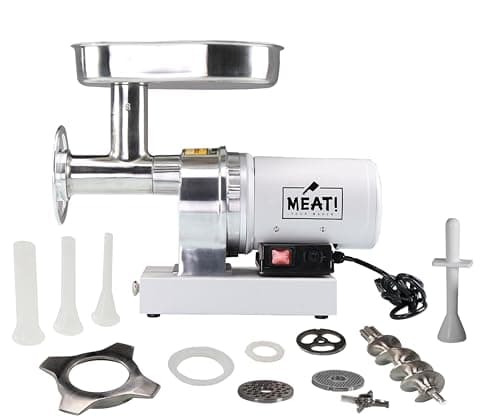
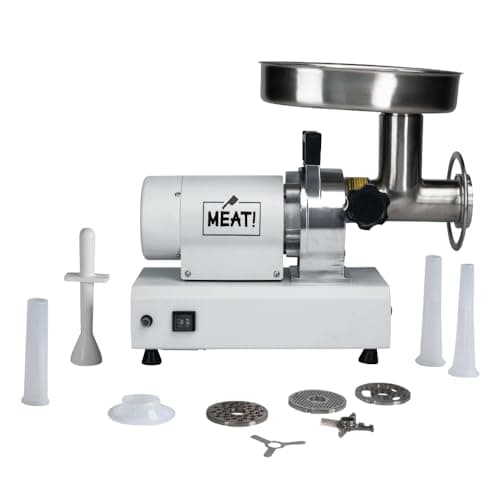
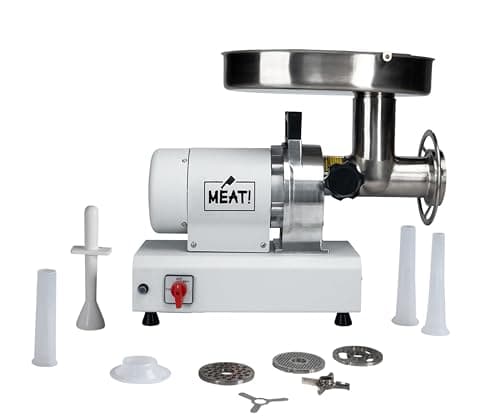
MEAT!'s smallest Pro-Grade grinder: a .5 HP #8 rated at 5.5 lb a minute, with stainless plates, an accessory drawer and a lifetime warranty to the original owner.
#ad · Price as of November 4, 2026 · Affiliate disclosure for the link to MEAT! Your Maker #22 Pro-Grade Meat Grinder (1 HP)
Put a LEM BigBite next to the MEAT! Your Maker grinder of the same number and the spec sheets line up to the decimal: .5 HP at the #8, .75 HP at the #12, 1 HP at the #22. That is unusual, and it is useful, because it deletes the argument people normally have about these machines. Nobody here is buying more motor. The two makers have simply spent the same motor differently, and they tell you so in two numbers that point in opposite directions: LEM publishes a higher pounds-per-minute rating, MEAT! publishes a longer warranty.
The short answer, by size
The brand is not the decision on this page. The size is, and then the brand inside that size. Here is how we would spend the money at each rung, with the reasoning below.
#8 (Light season, 1-2 deer): LEM. Same .5 HP motor, and LEM rates it at up to 7 lb a minute against MEAT!'s 5.5.
#12 (Moderate season, 3-5 deer): LEM, on the rating — about 11 lb a minute against a 7-to-10 range — and on 14 fewer pounds of machine. Take the MEAT! instead if the lifetime warranty is what you are actually buying.
#22 (Heavy season, 6+ deer or a half beef): MEAT!. Its 11-14 lb a minute brackets LEM's "up to 13", so the throughput argument runs out, and the lifetime warranty and all-stainless build are left standing. This is also the size where LEM's Amazon listing is hardest to buy from, which we cover below.
Horsepower is a tie, size for size
LEM states 0.5 HP on the BigBite #8, 0.75 HP on the #12 and 1.0 HP on the #22. MEAT! states .5 HP, .75 HP and 1 HP on the same three sizes. Head numbers match, motor labels match.
So the throughput ratings are the only performance figures left, and they do not match at all. LEM says up to 7 lb a minute at the #8; MEAT! says 5.5 lb a minute — and, on the same page, also says 4 to 6. LEM says about 11 at the #12; MEAT! says 7 to 10. LEM says up to 13 at the #22; MEAT! says 11 to 14. Only at the top of the ladder do the two claims overlap.
That self-contradiction is worth dwelling on. MEAT!'s #8 page carries both 5.5 lb per minute (330 lb per hour) and a 4-6 lb per minute range. A buyer cannot tell which is the conservative figure and which is the marketing one. We used 5.5 in the minute math below because it is the specific claim, and we show what the 4-6 range would do to the answer. LEM's "up to" phrasing has the same problem from the other direction: an "up to" number is a best case with coarse plates and well-chilled, well-trimmed meat, and nobody has to say so.
The ladder, side by side
Everything below is the maker's own figure. A blank means the maker does not publish it, which is itself part of the comparison.
A rating only means anything as time standing at the machine. At the Ohio DNR average of 52.19 lb of venison per deer (they weighed 115 whitetails from the 2017 gun season), here is one grinding pass at each maker's figure. We give MEAT! the kindest reading of its own numbers at the #12 and #22 by using the top of its published range.
Season
Venison lb
Size
LEM, per pass
MEAT!, per pass
Difference
2 deer (Light)
104
#8
15 min
19 min
4 min, to LEM
5 deer (Moderate)
261
#12
24 min
26 min
2 min, to LEM
6 deer (Heavy)
313
#22
24 min
22 min
2 min, to MEAT!
If minutes per pass is what you are optimizing, read meat grinder sizes explained before you pick a brand. Moving up one size number buys far more time than moving between these two badges.
Lifetime vs five years, and what each excludes
This is the real reason to pay MEAT!'s price. MEAT! warrants its grinders for the lifetime of the original owner, and the exclusions are the ones you would expect: commercial use voids it, and ordinary wear and tear is not covered. LEM gives five years and adds something a warranty document cannot: it states that it stocks replacement parts for past and present models, with lifetime customer support.
Those are different promises, not better and worse versions of one promise. A lifetime warranty is worth most if the machine fails structurally — a motor, a transmission — and worth nothing for the parts that wear, which on a grinder are exactly the parts that wear out: knives, plates, gaskets. LEM's parts shelf is worth most in the other case. Honest read: if you process a couple of deer a year for a decade you will replace knives and plates several times and probably never make a warranty claim on either machine. If you are the household that grinds a half beef every spring and a pile of deer every fall, the lifetime cover starts to matter.
One note on MEAT!'s exclusion that catches people: commercial use means doing processing for other people, including cutting a neighbor's deer for cash. If that is the plan, you do not have a lifetime warranty — and neither brand's home-grade grinder is the right machine for it anyway.
Stainless, gears and what neither maker publishes
MEAT! leads on the build claim. Its #12 and #22 listings describe all stainless steel construction, down to the last bolt. LEM specifies stainless for the motor housing, head, auger, knife and plates, which covers everything that touches meat but is a narrower claim.
LEM leads on the part you cannot see. It publishes all metal gears with roller bearings at the #12 and #22, and steel gears line-wide on the BigBite. MEAT! publishes no gear material, no bearing type and no transmission detail on any of the three product pages we cite. That is not evidence of a bad transmission; it is an absence, and on a machine whose whole job is torque through a gearbox we weight an absence against the maker who left it out.
Both lines are silent on the two things we most want. Neither publishes how long you can run the motor before it needs to cool, so we will not print a number for either. Neither lists a forward-reverse switch at any of these three sizes, which means that when a knife wraps in silver skin the procedure is identical on both: unplug, open the head, clear it, reassemble. If a reverse is a requirement it is a reason to look at a third brand rather than to pick between these two — see LEM vs Weston, where Weston's #22 is the one machine in our catalog that publishes one.
Weight and where the machine lives
MEAT! is the heavier machine at every size it publishes: 35 lb at the #8, 47 lb at the #12 and 57 lb at the #22, against LEM's 33.07 lb at the #12 and 49.6 lb at the #22. LEM does not publish a weight for the #8.
Fourteen pounds at the #12 sounds academic and is not. It is the difference between a grinder you lift out of a cabinet once a season and one that wants a permanent spot on a bench or a rolling cart. At the #22 both are bench machines and the 7 lb gap stops mattering. If your processing happens in a garage or on a porch table for two weekends a year the lighter machine is a real advantage; if it happens in a dedicated corner, ignore this section. Our 3-5 deer setup assumes the bench, which is part of why it leads with a #12.
One LEM-specific constraint worth planning around: LEM says not to use an extension cord with the #12's six-foot cord. That decides where the machine goes more firmly than its weight does.
Neither of these is a sausage stuffer, and the tubes in either box do not make one. A grinder pushes meat through a plate; a stuffer pushes it through a tube with a hand crank and no auger shearing it on the way. If casings are in the plan, budget for a dedicated stuffer — the reasoning is in sausage stuffer vs grinder attachment and the picks are in best sausage stuffers. For the seasoning-and-cure side of a first batch, see best sausage making kits.
MEAT! has one accessory LEM does not list for these sizes: a foot-pedal switch for the #12 and #22, sold separately. For one-person processing, where both hands are busy feeding, that is a genuinely useful thing to be able to buy later.
What you can actually buy
Checked against our price pipeline, last refreshed November 4, 2026. Five of the six machines on this page carry a normal Amazon offer. The LEM BigBite #22 does not: the listing is live and the model is not discontinued, but Amazon holds no featured offer for it, so there is no price in the buy box and the page shows "See All Buying Options" instead. Purchasable new offers from third-party sellers sit behind that link.
We are telling you rather than hiding it, because it changes the #22 recommendation in practice: if you want a one-click #22 today, MEAT!'s is the one that behaves like a normal purchase. Our buy buttons show the live price where Amazon publishes one and fall back to a tagged search when it does not, so a button with no price on it is that situation and not a bug.
Choose LEM if... choose MEAT! if...
Choose LEM BigBite if
You are buying a #8 or a #12, where LEM publishes the higher rating off the identical motor.
You want the gearbox specified — all metal gears on roller bearings, in writing.
You store the grinder between seasons and care about 14 lb at the #12.
You would rather have a parts shelf than a warranty certificate: LEM states it stocks parts for past and present models.
Choose MEAT! Your Maker if
You are buying a #22, where its 11-14 lb a minute brackets LEM's figure and the warranty is the only thing left on the table.
You intend this to be the last grinder you buy, and a lifetime warranty to the original owner is the point.
You want the all-stainless build claim and an accessory drawer or storage tray.
You process alone and want the option of the foot-pedal switch later.
+7 lb a minute on LEM's figure: a 2-deer season (about 104 lb) is roughly 15 minutes of feeding per pass
+Stainless motor housing, knife and plates; stuffing tubes and stomper included
+5-year warranty, and LEM says it carries replacement parts for past and present models
What it doesn't
−No reverse function is listed on LEM's spec page, so a knife wrapped in silver skin means stopping and opening the head
−LEM's listing says it is not for bones
−At 3-5 deer you feed about 60% longer than on LEM's own #12 (7 vs 11 lb a minute)
Skip this if…
…you regularly process three or more deer or split beef with family. LEM rates its own #12 at about 11 lb a minute and its #22 at 13, against this one's 7.
#ad · Price as of November 4, 2026 · Affiliate disclosure for the link to LEM BigBite #8 Electric Meat Grinder
MEAT! #8 — .5 HP, 5.5 lb/min
MEAT! Your Maker #8 Pro-Grade Meat Grinder (.5 HP)
6.8 /10
MEAT!'s smallest Pro-Grade grinder: a .5 HP #8 rated at 5.5 lb a minute, with stainless plates, an accessory drawer and a lifetime warranty to the original owner.
+Lifetime warranty to the original owner: the longest cover of any grinder in this lineup
+Coarse and fine stainless plates, a stainless stuffing plate and three tubes in the box, plus an accessory drawer
+MEAT! says it disassembles quickly and without tools for cleaning
What it doesn't
−The most expensive grinder on this page, and rated slower than LEM's BigBite #8 (5.5 lb a minute against 7)
−MEAT!'s own product page gives two different ratings for it, 5.5 lb a minute and 4-6
−35 lb per MEAT!'s listing, so it is not the one you lift in and out of a lower cabinet
Skip this if…
…you want the fastest machine for the money. The LEM BigBite #8 is rated at 7 lb a minute for less, and a 5-year warranty covers the span most households actually keep a grinder.
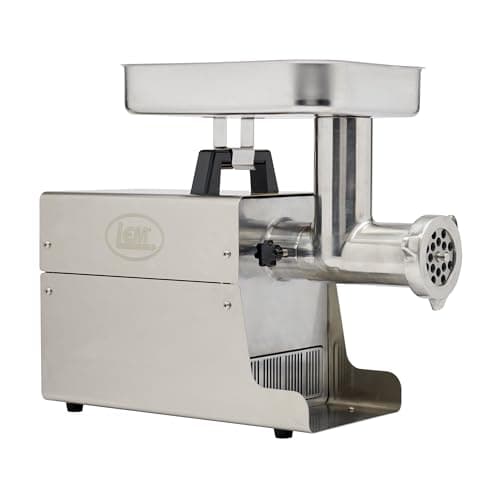
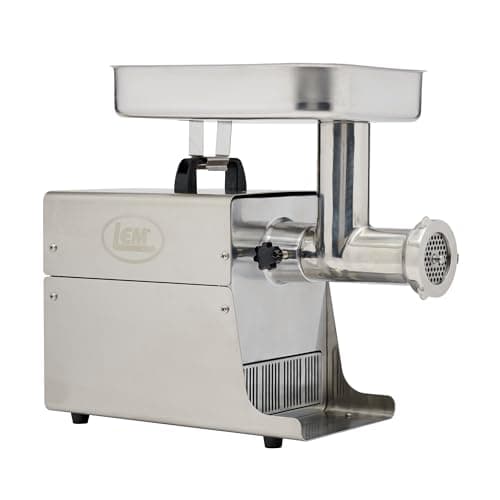
+The highest maker-rated output of any #12 we cover (11 lb a minute, against MEAT!'s 7-10 and Weston Pro's 6-9)
+All metal gears with roller bearings; stainless head, auger, knife and meat pan
+Storage drawer under the head keeps plates and the knife with the machine
What it doesn't
−The dearest #12 we list, and LEM's rated output is the reason to pay it
−No reverse function listed on LEM's spec page
−LEM says not to use an extension cord with its 6-foot cord, so plan the bench near an outlet
Skip this if…
…you'd rather have a lifetime warranty. The MEAT! #12 is rated slower (7-10 lb a minute) and carries MEAT!'s lifetime warranty against LEM's five years.
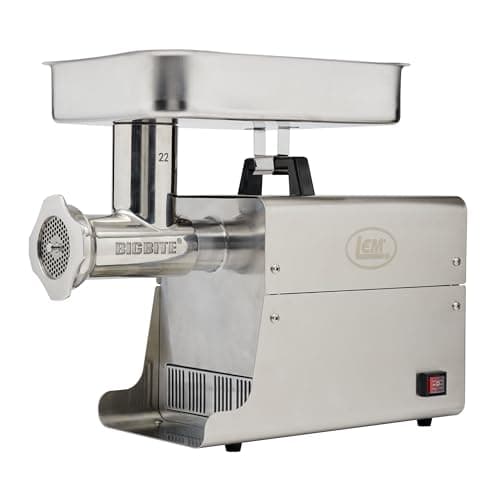
+13 lb a minute on LEM's figure: a 6-deer season (about 313 lb) is roughly 24 minutes of feeding per pass
+All metal gears with roller bearings, and a stainless motor housing, head, auger and knife
+LEM's listing says it handles raw chicken bones as well as venison and beef
What it doesn't
−49.6 lb: this lives on a bench or a cart, not in a kitchen cabinet
−Only 2 lb a minute faster than LEM's own #12 on paper, for a heavier machine
−No reverse function listed on LEM's spec page
Skip this if…
…you process five or fewer deer. LEM rates its #12 at about 11 lb a minute, close enough that the #22's extra weight rarely pays back below a Heavy season.
#ad · Price as of November 4, 2026 · Affiliate disclosure for the link to MEAT! Your Maker #22 Pro-Grade Meat Grinder (1 HP)
How we picked
Every pick, scored on the same published rubric
Each machine here is read end to end: the maker's spec sheet, the owner's manual and the warranty terms. We pull out the figures that decide whether it keeps up with your season — size number, motor rating, rated pounds per minute, capacity, duty cycle, gearing — confirm parts are still available, and score every pick on the same weighted rubric, so a score on one page means the same thing on the next. Then we show the season math, pounds per deer from the Ohio Division of Wildlife's yield study, so you can run it against your own freezer.
Is MEAT! Your Maker a good brand for meat grinders?+
On published specs, yes. The Pro-Grade line matches LEM's horsepower at every size, describes all-stainless construction down to the last bolt at the #12 and #22, and carries a lifetime warranty to the original owner. The gaps are what MEAT! does not publish: no gear or bearing material, no transmission detail, no duty cycle, and two different throughput figures on the same #8 page.
LEM or MEAT! Your Maker for deer processing?+
LEM at the #8 and #12, MEAT! at the #22. LEM rates its #8 at up to 7 lb a minute against MEAT!'s 5.5, and its #12 at about 11 against a 7-10 range. At the #22 MEAT!'s 11-14 brackets LEM's "up to 13", so the speed argument ends there and the lifetime warranty decides it.
Does MEAT! Your Maker really have a lifetime warranty?+
MEAT! publishes a lifetime warranty to the original owner, with commercial use and ordinary wear and tear excluded. Read that second exclusion carefully on a grinder: knives, plates and gaskets are wear items, so they are the parts you will buy again regardless. The cover is for a structural failure, not for consumables.
Which is faster, a LEM BigBite or a MEAT! Your Maker grinder?+
On the makers' own ratings, LEM at the #8 and #12 and roughly a tie at the #22. In practice the gap is minutes per pass, not hours: on a five-deer season at the #12 it is 2 minute at the top of MEAT!'s range and 13 minutes at the bottom of it.
Do either of these grinders have a reverse?+
Neither LEM nor MEAT! lists a forward-reverse switch at the #8, #12 or #22 on the product pages we cite. On both, a knife wrapped in silver skin means unplugging and opening the head. If a reverse is a requirement, Weston's Pro Series #22 is the machine in our catalog that publishes one, and its manual caps reverse at about five seconds at a time.
Can either brand grind deer bones?+
No. LEM's #8 listing says it is not for bones; its #22 listing allows raw chicken bones. MEAT! does not address bones on the product pages we cite, and silence is not permission. Deer bone is dense, and a home grinder that eats one has usually traded a knife and a plate for the privilege.
How long can you run either grinder without stopping?+
Neither company publishes a duty cycle for these models, so we will not print one. The practical rule is the same on both: if the motor housing is hot to the hand, stop and let it cool while you trim the next batch.
Specs come from the maker's own pages, manuals and maker-supplied listing copy (labeled as such); food-safety figures from USDA and university extension publications; yield from the Ohio Division of Wildlife; prices live from Amazon. Where a figure isn't published, we say so. Read the full method.