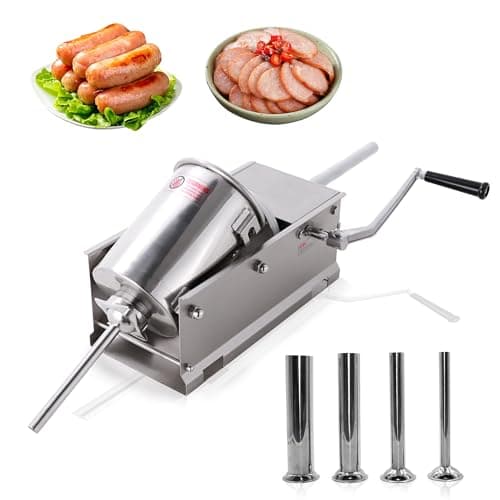
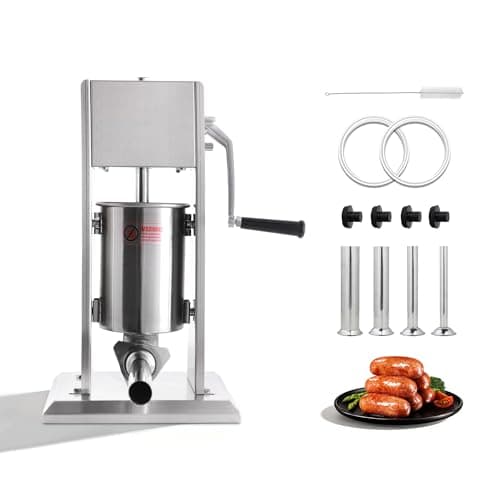
Buy a vertical stuffer unless your bench height or clearance rules it out. A vertical takes less bench space: Hakka's 7 lb vertical sits on an 11.8 by 8.7 inch footprint, while its horizontal twin runs 22.4 inches long. Choose a horizontal if a stuffer standing about 21 inches tall won't fit under your cabinets, or if you work at a high counter where a tall crank is awkward to turn.
Orientation gets more attention than it deserves. It changes where the machine sits and how you load it. It doesn't change what decides whether a stuffer keeps up with your season: capacity, gearing, the air valve and the tube sizes. That's why this comparison uses Hakka's SV-3 (vertical) and Hakka's SH-3 (horizontal): same maker, same 3-liter / 7 lb cylinder, same 16-38 mm nozzles, same two speeds. Hakka's manual describes both as rack-type stuffers with the same two-speed gear-reduction drive. What's left is the layout. We haven't bench-tested either; every figure below comes from Hakka's product page, data sheet or manual.
Side by side, per Hakka
| Spec | Hakka SV-3 (vertical) | Hakka SH-3 (horizontal) |
|---|
| Capacity | 3 liters / 7 lb | 3 liters / 7 lb |
| Overall size | 11.8 L x 8.7 W x 21.3 H inches | 22.4 L x 11.8 W x 13.4 H inches |
| Speeds | 2 (slow to fill casings, fast to return the piston) | 2 (slow for thorough filling, fast for efficiency) |
| Nozzles | 16, 22, 32, 38 mm stainless | 16, 22, 32, 38 mm stainless |
| Air release | Silicone gasket and built-in air release valve | Silicone seal rings; air release in the piston |
| Cylinder | Tiltable stainless barrel | Tiltable stainless barrel (140 x 200 mm) |
| Mounting | Not stated on the product page | Clamps to a table; data sheet says to clamp it firmly |
| Gear material | Not published | Not published |
| Warranty terms | Not published on the listing | Not published on the listing |
Two lines stand out: the footprint (the horizontal is almost twice as long) and the height (the vertical is about 8 inches taller). Everything that decides the work the machine can do is identical.
What changes when the cylinder lies down
Where it lives on the bench. A vertical stands up: small footprint, tall profile. At 21.3 inches before you tilt the barrel to load it, it needs clearance above, which is the usual reason people look at horizontals. A horizontal lies down: 13.4 inches tall, but 22.4 inches of bench length plus room at the outlet end for the casing to run off. On a short counter, that length is the problem instead.
Where the crank sits. A vertical rack stuffer drives the piston down from a gearbox on top, so on a standard counter you are cranking well above the work surface. On a horizontal, the whole drive sits lower and the crank turns at the side. Hakka's Amazon listing says the SH-3 adapts to high-platform operation, which is the maker's way of saying it suits a tall bench where a vertical's crank would end up at shoulder height.
Loading. Both Hakkas have a tilting barrel, and Hakka's manual describes the same routine for both: raise the plunger on the fast gear, take the cylinder out to clean or reload, fit the nozzle, put the casing on, and stuff on the slow gear. Neither layout loads by pouring mix into an open hopper; you pack the cylinder either way.
Stability and mounting
Horizontal makers pitch stability. Happybuy's listing for its 7 lb horizontal says the lower center of gravity makes the machine more stable while you stuff. That is plausible physics, and it is the maker's claim, not a measurement we have made. In practice, Hakka's SH-3 data sheet still says to clamp the machine firmly to a stable table or workbench to keep it from moving, and the same goes for a vertical: a stuffer that moves while you crank is how casings split. Clamp either one and stability stops being the deciding factor.
The same data sheet has a line worth taping to the wall: avoid hard or frozen meat, which can damage the machinery and clog the tube; the best meat is refrigerated but not frozen. That holds for any layout.
What orientation doesn't change
Our stuffer rubric doesn't score orientation at all, and that's deliberate. What decides a season is the same for both layouts:
- Capacity against your batch. A 7 lb cylinder takes 4 fills for a 25 lb batch whether it stands or lies down. At the Ohio DNR average of 52.19 lb of venison per deer, both Hakkas fit a light season of 1-2 deer.
- Gearing. Two speeds on both; neither Hakka publishes its gear material. For published steel gears, look at the Weston two-speeds, which are verticals.
- Tube range. Both stop at 16 mm. For snack sticks you want about 13 mm or less; Happybuy's horizontal and Hakka's 2-in-1 vertical both include a 10 mm tube. See stuffers for snack sticks.
- Air release. Both have one.
On our rubric the vertical scores 7.6 and the horizontal 7.5; the gap comes from the vertical's product page stating its air release valve outright. If you are moving up to a moderate season of 3-5 deer, the question isn't orientation but capacity: an 11 lb two-speed like the ones in our best sausage stuffers ranking.
Cleaning and upkeep are identical
Hakka's manual covers both layouts with one set of instructions, which says a lot about how much the orientation matters. After stuffing, raise the plunger on the fast gear, take out the cylinder and plunger, clear as much meat debris as you can with hot water, then clean with a brush or cloth and a detergent approved for meat-processing equipment. Rinse with clean warm water and let every part dry before reassembly. Penn State Extension adds a final step for anything that touched raw meat: sanitize with 1 tablespoon of chlorine bleach per gallon of water.
For upkeep, the same manual recommends food-grade lubricating oil on the rack and gear system and a new gasket about every six months, depending on how much you use the machine. The gasket matters on either layout: it is what keeps mix from squeezing back past the piston when the tube is small and the pressure is high. Neither schedule changes with orientation, so budget the same time and the same spare parts whichever one you buy.
Choose vertical if, choose horizontal if
Choose a vertical if
- Bench space is tight, but you have clearance above (about 21 inches for Hakka's 7 lb, plus tilt).
- You want the widest choice of steel-geared two-speed stuffers and larger cylinders.
- You work at a standard-height counter.
Choose a horizontal if
- Your stuffer has to fit under wall cabinets or on a shelf with limited height.
- You work at a high bench or table, where Hakka says the horizontal suits high-platform operation.
- You have bench length to spare, roughly two feet plus the casing run-off.
Still deciding whether you need a stuffer at all? If your grinder came with stuffing tubes, our stuffer vs grinder tubes comparison covers when those are enough. And for the process that feeds either machine, see how to make venison sausage.