Horizontal Sausage Stuffers: The Answer to a Low Cabinet
A vertical stuffer needs headroom above the bench that a lot of kitchens simply do not have. A horizontal trades that height for length, and almost nothing else.
#ad · Prices come live from Amazon, last checked November 4, 2026; where we have no verified live price we show none. Scores are ours, compiled from published specs, manuals and warranty terms, not bench tests. Tap a row for the full write-up.
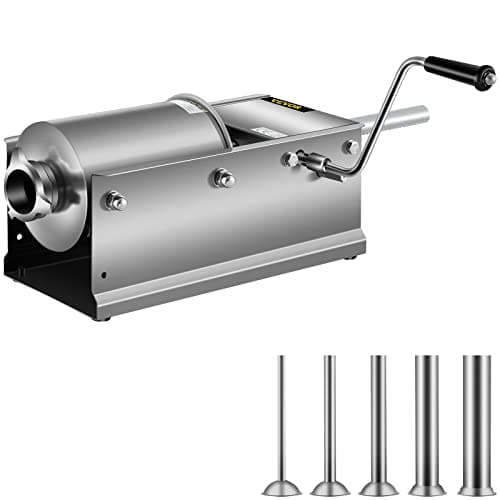
Buy the Hakka SH-3 if you want the horizontal with its numbers in writing. It is 13.4 inches tall, 22.4 inches long and 11.8 inches wide at 16.5 lb net, with two speeds — slow for thorough filling, fast for getting through a batch — a piston air release and four stainless tubes from 16 to 38 mm.
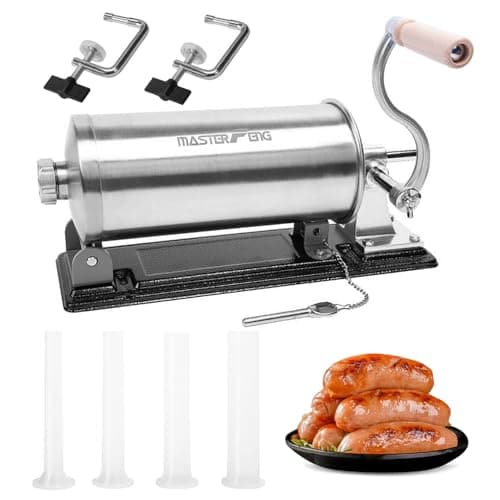
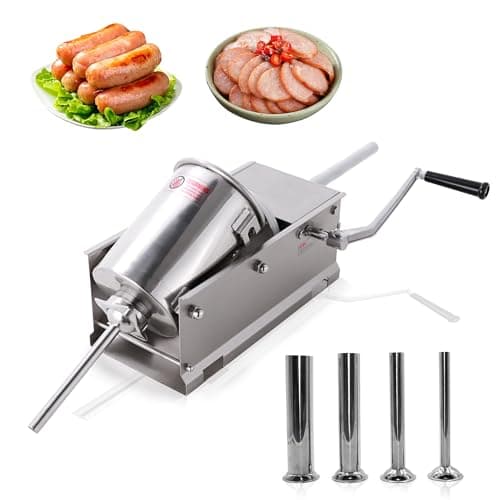
Buy the Happybuy if you make snack sticks, because it is the only horizontal here that ships a 10 mm tube, and 10 mm is what 19-21 mm collagen casings need. The Master Feng is the lightest and cheapest, with plastic funnels and no published speeds.
The measurement that decides it
A vertical stuffer works by pushing a piston down a cylinder, so its working height is roughly double the cylinder. Add a crank arc on top and a typical 7 lb vertical wants somewhere around two feet of clear air above the bench. Under a run of wall cabinets, that often is not there.
A horizontal lies the cylinder flat and pushes along it, so the whole machine is about the height of the cylinder itself — 13.4 inches on the Hakka. What it costs you is bench depth or length: 22.4 inches of it, which is most of a standard worktop's depth. Measure both before you choose, because this is genuinely the whole decision.
The three, side by side
Spec
Hakka SH-3
Happybuy 3 L
Master Feng 6 lb
Capacity
7 lb / 3 L
7 lb / 3 L, removable
6 lb
Published size
22.4 x 11.8 x 13.4 in., 16.5 lb
Not published
Not published
Speeds
2 (slow / fast)
2 (fast / slow)
Not published
Tubes
4 stainless: 16, 22, 32, 38 mm
5 stainless: 10, 16, 22, 32, 38 mm
4 plastic: 15, 19, 22, 25 mm
Air release
Piston air release + silicone seals
Not mentioned
Air-release silicone piston
Material
Stainless food-contact parts
304 stainless body, base, cylinder, tubes
Stainless cylinder
Mounting
Not stated
Not stated
Two G-clamps included
Tube sizes: the real separator
Three of the four Hakka tubes are sized for fresh links — 22 mm for breakfast sausage, 32 mm for bratwurst, 38 mm for thick coarse sausage — and its smallest is 16 mm. The Happybuy adds a 10 mm, and that one tube is the difference between a stuffer that can make snack sticks and one that cannot.
The Master Feng's funnels are plastic, which is the one spec in this group we would treat as a real downgrade: plastic tubes flex under pressure and are harder to get genuinely clean at the shoulder. If you are buying one anyway, buy it knowing that.
Clamps, feet and pushback
A horizontal pushes along the bench rather than down into it, so there is nothing but friction holding the machine still. The Master Feng includes two G-clamps for exactly this reason. The other two do not state how they are held; if yours is not clamped, expect to brace it with your body on the fast setting, which is awkward when both hands should be on the casing.
What none of them publishes
Gear material and warranty length. All three listings are silent on both, which is the main thing separating this class from a LEM or a Weston vertical, where steel gearing and two-to-five-year terms are stated. If you want the gear train in writing, the honest answer is a vertical from a maker that publishes it — and our best sausage stuffers page is where those sit.
When to buy a vertical instead
If you have the headroom, a vertical is the default: the whole class publishes more, the gearing is usually stated, and gravity helps load the cylinder. Horizontals earn their place in two situations — a low cabinet run, and a high bench where you want the crank at elbow height rather than overhead.
#ad · Price as of November 4, 2026 · Affiliate disclosure for the link to Master Feng 6 lb Horizontal Sausage Stuffer
What we judged them on
Published dimensions first — this is a class bought on fit, so a maker that will not state its footprint loses marks. Then speeds and pressure control, tube sizes with particular weight on the smallest one, material of the food-contact parts, and how the machine is held still. Everything comes from maker and seller documentation cited below; none of it is a test result.
How we picked
Every pick, scored on the same published rubric
Each machine here is read end to end: the maker's spec sheet, the owner's manual and the warranty terms. We pull out the figures that decide whether it keeps up with your season — size number, motor rating, rated pounds per minute, capacity, duty cycle, gearing — confirm parts are still available, and score every pick on the same weighted rubric, so a score on one page means the same thing on the next. Then we show the season math, pounds per deer from the Ohio Division of Wildlife's yield study, so you can run it against your own freezer.
What is the advantage of a horizontal sausage stuffer?+
Height. The Hakka SH-3 stands 13.4 inches tall, per Hakka, so it fits under a run of wall cabinets where a vertical's piston and crank will not. The cost is bench length: 22.4 inches of it.
Can a horizontal stuffer make snack sticks?+
Only if it has a small enough tube. The Happybuy includes a 10 mm tube, which suits 19-21 mm collagen casings; the Hakka SH-3's smallest is 16 mm and the Master Feng's is 15 mm.
Do horizontal sausage stuffers clamp to the bench?+
The Master Feng includes two G-clamps. Hakka and Happybuy do not state how their machines are secured, which matters because a horizontal pushes along the bench rather than into it.
Are horizontal stuffers as strong as vertical ones?+
Unknown from the listings — none of the three publishes gear material or warranty length. Vertical stuffers from LEM and Weston do state steel gearing and multi-year terms, which is the real reason to prefer one if you have the headroom.
Specs come from the maker's own pages, manuals and maker-supplied listing copy (labeled as such); food-safety figures from USDA and university extension publications; yield from the Ohio Division of Wildlife; prices live from Amazon. Where a figure isn't published, we say so. Read the full method.