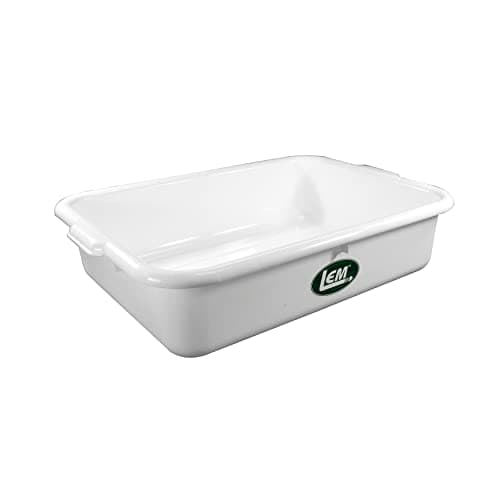
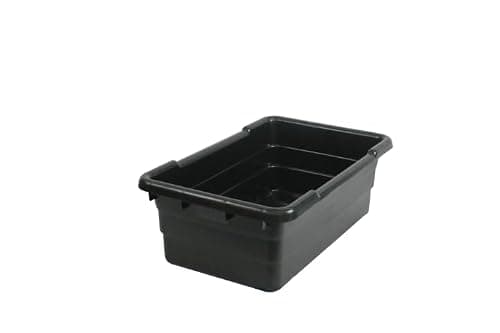
For a 3-5 deer season, buy the six-pack of UltraSource food-grade totes: 50 lb and 1.38 cu ft each, about 300 lb of holding space in one order. If you want one good lug instead, buy the LEM Heavy Duty Meat Lug — it is the only container here with a published temperature range, rated from -30 °F to 183 °F so it can go in the freezer and take hot wash water without cracking, and at 7 inches deep it doubles as a mixing tub.
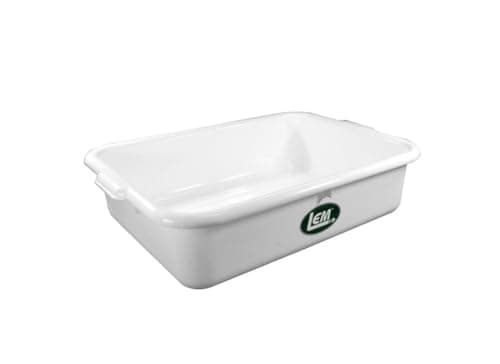
The budget pick is LEM's Economy Meat Lug: the same 50 lb rating at 5 inches deep, low enough to sit under a BigBite grinder head.
Why a lug, not a bowl
A processing day is a sorting problem before it is a cutting problem. At any moment you have bone-in cuts waiting, boneless cuts to wrap, trim for grinding, fat to blend in, and ground meat coming off the grinder — and every one of those needs to be a separate pile that is not touching the others. Kitchen mixing bowls run out after about forty pounds of meat, and the moment you are short a container, something ends up on a board where it warms up.
That matters for food safety, not just tidiness. USDA's ground-beef guidance is not to leave ground meat at room temperature for more than two hours, and no more than one hour at 90 °F and above. Penn State Extension treats an unbroken cold chain and clean equipment as the two controls that matter when you process wild game at home. A stack of lugs is how you keep meat moving between the table and the cold.
The five, side by side
| Spec | UltraSource 6-pack | LEM Heavy Duty | LEM Economy | LEM liners | HDPE board |
|---|
| Capacity | 50 lb x 6 | 50 lb | 50 lb | 25 liners | n/a |
| Depth | 1.38 cu ft each | 7 in | 5 in | 22-3/4 x 20 in | 1/2 in thick |
| Material | Reinforced polypropylene | Food-grade HDPE | Food-grade HDPE | LDPE, 1.5 mil | HDPE |
| Freezer rating published | No | Yes, -30 to 183 °F | No | No | n/a |
| Stacking | Nest empty, cross-stack loaded | Lid sold separately | Lid sold separately | n/a | n/a |
| Certification stated | Food grade | Food grade | Food grade | Plastic named, no certification | NSF stamped |
| Warranty | Not published | 1 year | 1 year | Not published | Not published |
How many you actually need
Work back from the season. At the Ohio Division of Wildlife average of 52.19 lb of venison per deer (115 deer weighed in the 2017 gun season), a 50 lb lug holds roughly one deer's meat. But you do not need one lug per deer — you need enough containers for the stages running at once.
| Your season | Lugs in play at once | Buy |
|---|
| 1 deer | 2 — trim, and cuts to wrap | Two heavy-duty lugs, or one plus a liner box |
| 2 deer | 3 — cuts, trim, grind | Three lugs |
| 3-5 deer | 4-5 — add fat, and a second grind batch | The six-pack of totes |
| 6+ deer, or deer plus a hog | 6+ and a plan for rotating them through the fridge | Six-pack plus two heavy-duty lugs |
The six-pack is six totes at 1.38 cu ft each, which UltraSource says nest empty to save space and cross-stack when loaded. That cross-stacking is the detail that makes a six-pack workable in a garage: a full tote can sit on a full tote rather than needing its own square foot of floor.
The three specs that matter
- A published temperature range. Only LEM's heavy-duty lug gives one: -30 °F to 183 °F, and LEM says it will not crack, split or warp in the freezer. If you want to park a lug of trim in a chest freezer to firm the meat before grinding — which is exactly what you should be doing — that is the spec to buy on.
- Depth. Seven inches versus five sounds trivial until you hand-mix fat into twenty pounds of grind and it goes over the sides. The shallow lug has its own use: LEM says the economy model's low profile fits under a BigBite grinder head, which is where you want a wide, shallow container.
- Stacking and nesting. Six totes you cannot nest is a storage problem eleven months a year.
What none of these publish is external dimensions for the totes, so measure your fridge shelf before you assume six of them will chill at once.
Lugs and the cold chain
The reason to buy a freezer-rated lug is the grinding routine. Meat grinds cleanly when it is firm and cold — LEM wants meat at 40 °F or colder for grinding — and the easiest way to get a whole lug of trim there is to put the lug itself in the chest freezer for half an hour. A lug with no published cold rating is a lug you are guessing with.
Six totes of meat also need somewhere cold to live between stages, and that is the part people under-plan. Our freezer space for a deer page does the cubic-foot math, and the 3-5 deer setup puts lugs in the context of the whole chain.
Picks for this job
Start with three containers
Cuts, trim and grind running at once is the minimum. Add the fourth and fifth when fat and a second batch join in.
Best for 3-5 deer
UltraSource UltraTotes Food-Grade Tote Boxes, 6 Totes, No Lids
Six totes in one order: the cheapest route to enough containers for a 3-5 deer day, and they nest empty.
Best single lug
LEM Heavy Duty Meat Lug
The one to buy singly: 7 in deep and rated -30 to 183 degrees F, so it works as a freezer tub and a mixing tub.
Best budget lug for 1-2 deer
LEM Economy Meat Lug
Shallower and cheaper, with the same 50 lb rating and a low profile that sits under a grinder head.
Cleanup, liners and sanitising
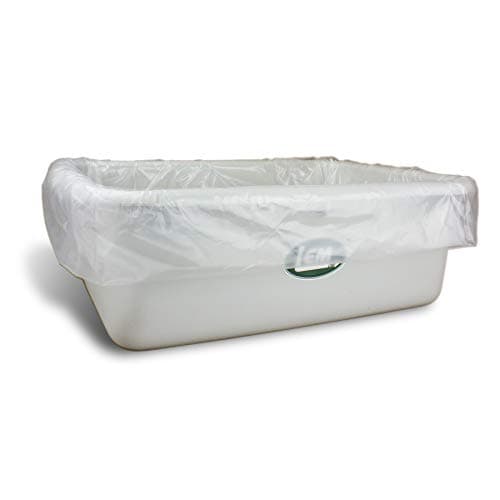
Washing five lugs at the end of a twelve-hour day is the job nobody accounts for. Liners are the honest fix: LEM's are 1.5 mil LDPE at 22-3/4 by 20 inches, twenty-five to a box, one per lug-load, and cleanup becomes lifting a bag out. Two caveats from the listing itself: the copy names the plastic but does not state a food-contact certification, and the liners are cut for LEM's lugs and may not fit other brands.
Lined or not, lugs still need washing and sanitising before they go away, for the reason LEM prints in its grinder manual: any part exposed to raw meat can harbour bacteria. Wash first — sanitiser does not work through grease — then sanitise, then dry. Ohio State Extension's guidance on freezing meat, poultry and game and NCHFP's freezing-meats page both treat clean containers and proper packaging as part of the same job.
What not to use
- Household storage bins. They are not food-grade and nothing on the box says what the plastic is. The lugs here all state food-grade HDPE or reinforced polypropylene.
- Bin bags as liners. General-purpose refuse sacks are not sold for food contact.
- Coolers as working containers. Fine for transport and holding, wrong for the bench: you cannot see what is in the bottom, and you cannot get a lug of trim out of a chest cooler without reaching into it.
- A wooden board as the cutting surface. Use NSF-stamped HDPE you can actually sanitise — the 24 x 18 inch board here is stamped and rated for commercial dishwashers, though its own listing warns it will not fit a home sink.
Get the containers right and the rest of the day gets simpler. Our how to process a deer at home guide walks the sequence the lugs serve, and deer processing kits covers the knives that feed them.
How we picked
Every pick, scored on the same published rubric
Each machine here is read end to end: the maker's spec sheet, the owner's manual and the warranty terms. We pull out the figures that decide whether it keeps up with your season — size number, motor rating, rated pounds per minute, capacity, duty cycle, gearing — confirm parts are still available, and score every pick on the same weighted rubric, so a score on one page means the same thing on the next. Then we show the season math, pounds per deer from the Ohio Division of Wildlife's yield study, so you can run it against your own freezer.
Every figure on a card links to the document it came from, and the live price is checked daily. Rankings are earned on the rubric, never paid for. The rubric and weights are on the How We Pick page.