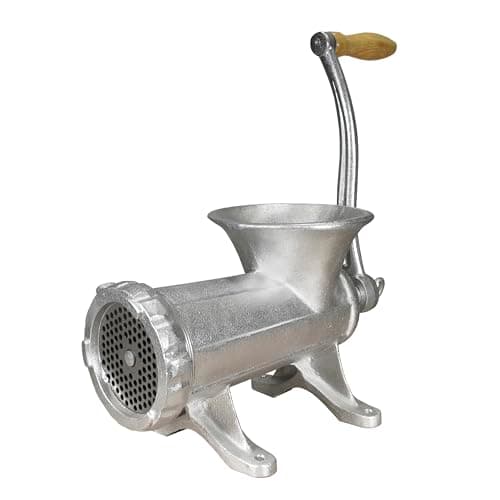
Under a hundred dollars, the grinder we would actually buy is the Weston #22 manual: a hand crank with a bigger head than any electric in this band, a stuffing kit in the box, no run limit and nothing to burn out. If it has to be electric, the Gourmia 500W is the pick — not because it is powerful, but because it is the only listing here that states a plain wattage instead of a fantasy one.
The watt number is a stall figure
Every cheap electric grinder in this band leads with a number like 2800W or 3000W “max”. A machine that genuinely drew 3000 watts would trip a 15-amp kitchen circuit on its own. These are peak or locked-rotor figures — roughly, what the motor pulls in the instant before it stalls — and they tell you nothing about how much meat the machine will move.
One listing in this band publishes both numbers, and it is worth reading carefully. CHEFFANO states a “normal rated power up to 350W” and that “the peak value can reach up to 2800 watt”. Same machine, two numbers, an eightfold gap. That is the size of the exaggeration you are looking at every time you see a bare “max watts” figure with no rated number beside it.
| Grinder | Headline number | Rated number |
|---|
| CHEFFANO | 2800W max | 350W — published |
| Gourmia | 500W | 500W — no peak claim made |
| Typical sub-$100 listing | 2000-3200W max | Not published |
| LEM MightyBite #8 (for scale, ~$250) | 500W | 500W |
Read that last row twice. A $250 LEM MightyBite is a 500W grinder. Any sub-$100 machine claiming six times that is not six times the grinder. This is the same trap our home-use roundup covers under “buying on peak watts”.
What $100 actually buys
Three real options, and an honest word about each:
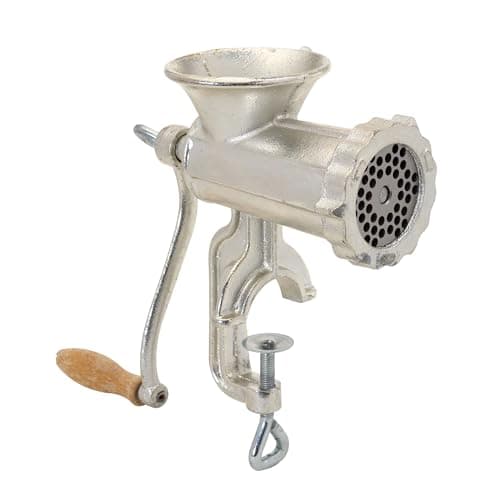
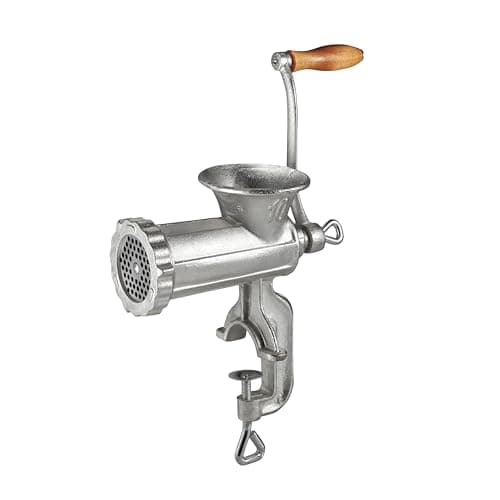
- A hand crank with a real head. A #10 or #22 manual is a proper plate-and-knife grinder. It has no duty cycle to exceed and no motor to burn. The cost is your arm and your time.
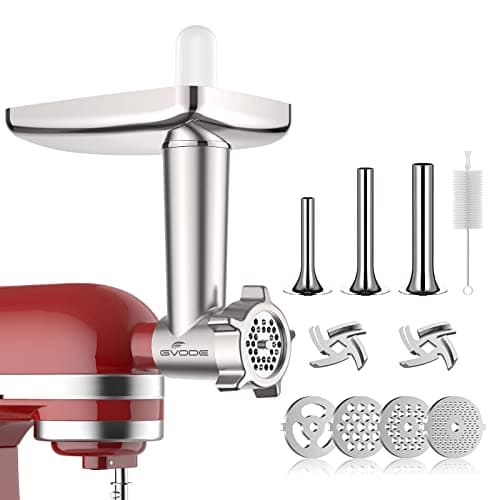
- A stand-mixer attachment, if you already own the mixer. You are buying a grinder head and borrowing a motor that cost several hundred dollars.
- A light-duty electric. 350-500W of real motor, three plates and a reverse switch. It will grind for a household; it will not grind a deer in an afternoon.
What $100 does not buy at all: a published pounds-per-minute rate, a stated run limit, or a warranty term. None of the six machines on this page publishes a duty cycle, and only the attachment comes from a company with a parts catalog you can order from in five years.
The six, side by side
| Spec | Weston #22 manual | Gourmia 500W | CHEFFANO | LEM #10 cast | GVODE KA head |
|---|
| Drive | Hand | 500W electric | 350W electric | Hand | Your mixer |
| Head size | #22 | Not stated | Not stated | #10 | Mixer hub |
| Plates | Per Weston | 3: fine, medium, coarse | 3: 2, 5, 7 mm | Per LEM | 3 |
| Reverse | n/a | Yes | Yes (REV) | n/a | n/a |
| Stuffing kit included | Yes | Yes | Yes | Per LEM | 3 tubes |
| Certification stated | No | No | ETL | No | No |
| Run limit published | None needed | No | No | None needed | Mixer's limit applies |
| Dishwasher safe | No | No | Explicitly not | No | Per GVODE |
Hand crank or cheap electric
The honest split, by how much meat you actually put through in a session:
| Per session | Buy | Why |
|---|
| Under about 10 lb | Weston #10 manual, or the LEM cast iron | Cranking is fine at this volume and nothing can burn out |
| 10-25 lb | Weston #22 manual | Bigger head, fewer passes, still no motor to worry about |
| 10-25 lb, but you want a motor | Gourmia 500W | A real 500W with reverse; take breaks it cannot tell you to take |
| You own a KitchenAid | GVODE attachment | A real grind for the price of a head |
| A whole deer, 52.19 lb of meat | Nothing on this page | See grinders for deer |
At the Ohio DNR average of 52.19 lb of venison per deer, a single animal is well beyond what any machine on this page is built for in one sitting. That is not a reason to avoid them — it is a reason to buy one knowing what it is for. Our electric vs manual page does the minutes-per-season arithmetic.
The attachment route
If there is a KitchenAid on your counter, the cheapest honest grinder you can buy is a grinder head for it. You get a real auger, a real knife and a real plate, driven by a motor built to a standard no sub-$100 grinder motor is. The GVODE metal attachment is our pick in this band; the full field is in KitchenAid grinder attachments.
The limit is the mixer, not the head: a stand mixer is not built for a long grinding session and will get warm. Where that ceiling sits, and when a standalone takes over, is the subject of attachment vs standalone.
When to spend more
Two clear triggers. The first is volume: once you are grinding a whole animal, the machine needs a published rate and a real duty cycle, and those start at the #8 electrics. The second is sausage: a stuffing kit in a cheap box is not the same as a stuffing plate and a slow speed, and the difference shows in the texture — see grinder and stuffer combos.
If you are sizing a grinder properly rather than shopping to a price, grinder sizes explained is the page that matches head size to season.
How we ranked these
On the grinder rubric used across this site — season throughput (30), build (20), venison handling (15), cleanup (10), parts and warranty (15), value (10) — and then weighted toward what published information exists at all. In a band where most listings publish only a peak wattage, a maker who states a rated figure, a plate set or a certification is telling you something checkable, and we score that.
We have not bench-tested any of these. Every figure comes from the maker's listing copy or spec page, cited on each card. Where a listing gives only a “max watts” number we say so rather than repeating it as though it described the motor.
How we picked
Units we claim to have bench-tested: none
Plenty of sites say they ground two hundred pounds through every grinder. We didn't, and we say so. What we do instead: read the maker's spec sheet, manual and warranty terms, record the figures that decide whether a machine keeps up with your season (size number, motor rating, rated pounds per minute, capacity, duty cycle, gearing), check parts availability, and score each pick on a published rubric. Then we show the season math — pounds per deer from the Ohio Division of Wildlife's yield study — so you can redo it with your own numbers.
Scores are editorial judgments from that documented research, not lab results. Nobody pays for placement. The rubric and weights are on the How We Pick page.