Electric vs Manual Meat Grinder: Where the Hand Crank Runs Out
Same maker, two ways to grind. The hand grinder is quiet, cheap and needs no outlet; the electric does in minutes what takes the crank an hour. Your deer count decides.
#ad · Price as of Sep 19, 2026 · Affiliate disclosure for the link to LEM BigBite #8 Electric Meat Grinder
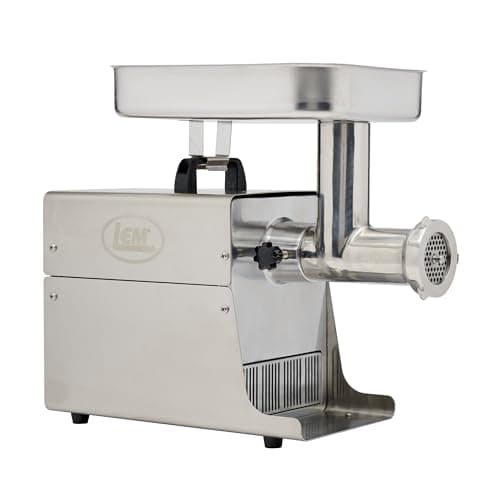
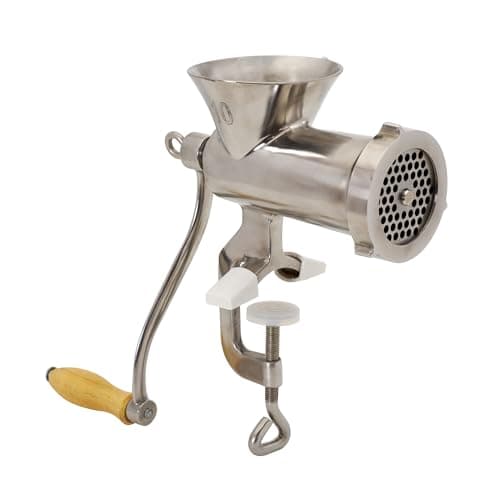
Go manual if you grind one deer or less a season and don't mind cranking: LEM rates its #10 hand grinder at 2-4 lb a minute. Go electric at two deer and up, or whenever you want a second, finer pass. LEM's BigBite #8 is rated at up to 7 lb a minute and feeds a 2-deer season in about 15 minutes per pass.
The two side by side
Spec
LEM #10 Stainless Hand Grinder
LEM BigBite #8 Electric
Power
Your arm
0.5 HP, 110V
Rated output
2-4 lb/min
Up to 7 lb/min
Plates
Coarse 3/8 in., fine 3/16 in.
4.5 mm, 10 mm, stuffing
Mount
Clamps to surfaces up to 1-1/2 in. thick
Countertop, 28.66 lb
Stuffing
3 tubes and a stuffing star
3 tubes and a stomper
Warranty
1 year
5 years
Needs
A sturdy table
An outlet within 6 feet (LEM advises against extension cords)
Both ratings come from LEM, which makes them about as comparable as published figures get. At the Ohio DNR average of 52.19 lb of venison per deer:
Deer
Venison lb
Hand #10, one pass
BigBite #8, one pass
1
52
13-26 min
7 min
2
104
26-52 min
15 min
3
157
39-79 min
22 min
5
261
65-131 min
37 min
Time isn't the only cost of a slow grind. The longer meat sits out, the warmer it gets, and warm meat is what smears and clogs. STX's manual warns that meat that isn't cold enough may ball up in the back of the grinding head; Weston's manuals ask for meat at 32-34°F. With a hand grinder, work in small batches straight from the fridge or a cooler and put the rest back while you crank.
What changes besides speed
Your hands. With a hand grinder, one hand cranks and the other feeds. With an electric, one hand works the stomper and the other stays free to load the tray. That sounds minor until you're an hour in.
Consistency. A motor turns at the same speed from the first pound to the last. A crank slows down as you tire, and the temptation to skip the fine pass grows with it.
Setup and storage. The hand grinder weighs a few pounds and lives in a drawer. The #8 weighs 28.66 lb by LEM's spec and wants a cabinet and an outlet nearby.
Independence. No power, no problem for the hand grinder: a cabin, a camp, a storm that takes out the power with a deer hanging. It's also a grinder with no motor to wear out.
Warranty. LEM backs the #10 for 1 year and the BigBite #8 for 5. On a motorized machine that gap is worth more.
Stuffing sausage with each
Both grinders double as slow stuffers. LEM's stainless #10 comes with three plastic tubes (1/2, 3/4 and 7/8 inch outer diameter) and a stuffing star; the BigBite #8 with three tubes (1/2, 1 and 1-3/8 inch) and a stomper. By hand, one hand cranks and the other manages the casing, so a helper makes a big difference. On the electric, the motor does the turning, so your hands are free for the meat and the casing. Either way, a grinder is a slow way to stuff more than a few pounds, and the reasons are in sausage stuffer vs grinder attachment.
Starting manual and upgrading later
It's a sensible path, with one catch: the parts don't carry over. LEM says its standard grinder knives and plates won't fit the stainless #10 hand grinder, so the plates you collect for it stay with it. Budget for the electric's plates and a spare knife when you move up. Keep the hand grinder anyway. It works with no power, it packs into a camp box, and it's the backup when the electric is mid-repair in the middle of the season.
Noise and cleanup
A hand grinder is close to silent. LEM markets the BigBite #8's noise-dampening design, but it's still a motor in the kitchen. Cleanup is closer than you'd think: LEM says the stainless #10's polished surface makes cleaning hassle-free, and the BigBite's listing says it disassembles easily with stainless parts. The electric has more to wash and a motor base you wipe down rather than rinse. Dry everything fully on both.
The in-between options
If a BigBite feels like too much of a jump, there are two steps between. A KitchenAid grinder attachment uses a mixer you may already own, though KitchenAid publishes no rate or run limit for it. LEM's MightyBite #8 is a lighter 500 W electric rated at 4-5 lb a minute with a 2-year warranty. Both beat a crank on effort; neither matches the BigBite's build. Our best manual meat grinders ranks the hand options, and our best meat grinders for deer the electrics.
If you can only buy one
Be honest about why you're reading this. If you already own a hand grinder and it's the reason your second deer took all weekend, buy the electric; you've already found the limit. If you're buying your first grinder for one deer and some store-bought meat, the hand grinder is the smarter buy: you lose little at that volume and keep a tool that never needs an outlet. And if you're not sure your season will stay small, the BigBite #8's 5-year warranty covers a lot of growing seasons.
Choose manual if... choose electric if...
Choose a manual grinder if
You grind one deer a season or less, or a few pounds of store-bought meat at a time.
You want a grinder that works without power.
Storage space is tight.
Choose an electric grinder if
You process two or more deer, or grind everything twice.
You want the longer warranty that comes with LEM's motorized line.
You expect your season to grow.
Want the whole size ladder, not just these two? See our meat grinder sizes guide. And if you're going manual for a Light season, the setup for 1-2 deer shows the rest of the kit.
In detail
The contenders, in full
Manual pick
LEM #10 Stainless Steel Clamp-On Hand Grinder
5.9 /10
The hand grinder worth owning: stainless, 2-4 lb a minute by LEM's figure, two plates and stuffing tubes. The honest answer for one deer.
+Stainless: no tinning to wear through, and it cleans without the rust worry of cast iron
+Two plates for a coarse-then-fine grind, plus stuffing tubes
+Works without power: a cabin, a camp or a power outage
What it doesn't
−LEM says standard LEM grinder knives and plates will not fit it; buy parts made for this model
−Clamps only to surfaces up to 1-1/2 in. thick
−At 2-4 lb a minute, one deer is 13-26 minutes of cranking per pass
Skip this if…
…you process two or more deer. At 2-4 lb a minute a 2-deer season (about 104 lb) is 26-52 minutes of cranking per pass; LEM rates its BigBite #8 at 7 lb a minute, about 15.
+7 lb a minute on LEM's figure: a 2-deer season (about 104 lb) is roughly 15 minutes of feeding per pass
+Stainless motor housing, knife and plates; stuffing tubes and stomper included
+5-year warranty, and LEM says it carries replacement parts for past and present models
What it doesn't
−No reverse function is listed on LEM's spec page, so a knife wrapped in silver skin means stopping and opening the head
−LEM's listing says it is not for bones
−At 3-5 deer you feed about 60% longer than on LEM's own #12 (7 vs 11 lb a minute)
Skip this if…
…you regularly process three or more deer or split beef with family. LEM rates its own #12 at about 11 lb a minute and its #22 at 13, against this one's 7.
#ad · Price as of Sep 19, 2026 · Affiliate disclosure for the link to LEM BigBite #8 Electric Meat Grinder
How we picked
Units we claim to have bench-tested: none
Plenty of sites say they ground two hundred pounds through every grinder. We didn't, and we say so. What we do instead: read the maker's spec sheet, manual and warranty terms, record the figures that decide whether a machine keeps up with your season (size number, motor rating, rated pounds per minute, capacity, duty cycle, gearing), check parts availability, and score each pick on a published rubric. Then we show the season math — pounds per deer from the Ohio Division of Wildlife's yield study — so you can redo it with your own numbers.
For one deer a season or less, a manual grinder is enough and costs far less. At two or more deer, or if you double-grind, an electric saves hours: LEM rates its BigBite #8 at 7 lb a minute against 2-4 for its #10 hand grinder.
Meat grinder or food processor: what's the difference?+
A food processor chops with a spinning blade in a bowl, so pieces come out uneven and fat can smear. A grinder pushes meat through a knife and a perforated plate, so every piece exits the same size. For burger and sausage texture, and for anything with sinew, use a grinder. A food processor will do for a pound of well-trimmed meat in a pinch.
Can I use my hand grinder's plates on an electric grinder later?+
Usually not. Plates are sized to the head, and LEM says its standard grinder knives and plates won't fit its stainless #10 hand grinder. Plan on new parts when you move up.
How long does it take to grind a deer by hand?+
About 13-26 minutes of cranking per pass for an average deer (52 lb at the Ohio DNR figure), at LEM's 2-4 lb a minute rating for its #10.
We haven't bench-tested this gear and we don't pretend to. Specs come from the maker's own pages, manuals and maker-supplied listing copy (labeled as such); food-safety figures from USDA and university extension publications; yield from the Ohio Division of Wildlife; prices live from Amazon. Where a figure isn't published, we say so. Read the full method.