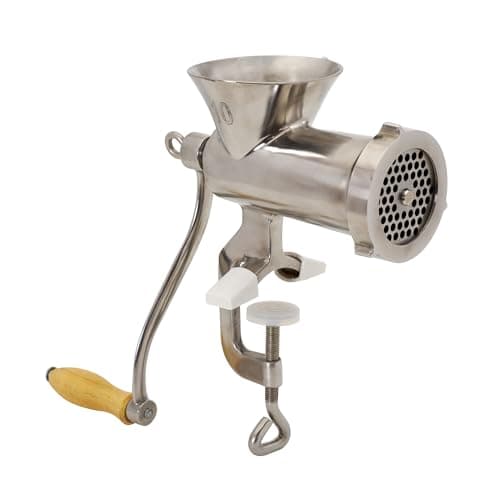
Best Manual Meat Grinders, and When a Hand Crank Is Enough
A hand grinder is the honest answer for a one-deer season. Here are the ones worth clamping to your table, and the arithmetic that tells you when you've outgrown them.
#ad · Prices come live from Amazon, last checked Sep 19, 2026; where we have no verified live price we show none. Scores are ours, compiled from published specs, manuals and warranty terms, not bench tests. Tap a row for the full write-up.
If you process one deer a season and don't mind cranking, a hand grinder is the honest answer, and LEM's #10 stainless is the one we'd buy: stainless steel, two plates, stuffing tubes, and a rating of 2-4 lb a minute by LEM's own figure. Past about two deer, or once you want every pound through a fine plate too, the arithmetic turns against your forearm.
Hand grinders don't get much respect in the upgrade conversation, and they should. They're quiet, they need no outlet, they fit in a drawer, and there's no motor to burn out. They score low on our rubric because season throughput carries the most weight, and a person turning a crank can't match a motor. Within their class, the ranking below is about build, plates, clamp and support.
When a hand grinder is honestly enough
LEM rates both its stainless #10 and its tinned cast iron #10 at 2 to 4 lb of meat per minute. None of the other makers here publishes a rate, so we use LEM's as the yardstick for a #10. Against the Ohio DNR average of 52.19 lb of venison per deer, the cranking time looks like this:
Season
Venison lb (Ohio average)
One pass at 2-4 lb/min
Coarse + fine (two passes)
1 deer
52 lb
13-26 min
26-52 min
2 deer
104 lb
26-52 min
52-104 min
3 deer
157 lb
39-79 min
78-158 min
So: one deer, a hand grinder is plenty. Two deer, it works if you don't mind the time or have a second pair of arms. Three or more, buy an electric; our electric vs manual comparison puts the two side by side, and the setup for 1-2 deer shows how a hand grinder fits into a full Light-season kit.
Signs you've outgrown it
You split the grinding across two evenings because your arm or your patience gave out.
You've started skipping the fine pass, even for sausage.
The clamp walks across the table and you've taken to having someone hold it down.
The second deer arrives before the first one is ground.
You're stuffing more than a few pounds of sausage through the grinder's tubes.
Any two of those and it's time to look at our best meat grinders for deer. Keep the hand grinder anyway: it's the backup when the power goes out and the tool for a camp or cabin.
Stainless or tinned cast iron
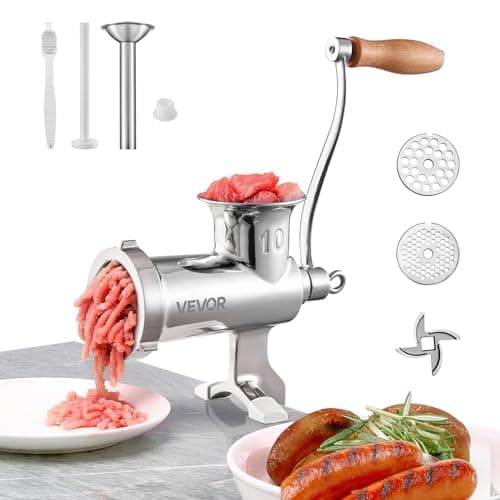
This is the real choice in hand grinders. Stainless (LEM #10 stainless, VEVOR) resists rust and cleans easily; LEM calls its stainless #10 rust-resistant with a polished surface. Tinned cast iron (LEM #10 cast, Weston #10 and #22) is heavy and cheap, and the tin plating is there, in LEM's words, to prevent corrosion and rust. The catch is care: LEM's listing for its cast grinder says hand wash only and dry completely before storing. Stainless costs more and asks less of you at cleanup; tinned cast iron asks you to towel it off every time.
One parts note that trips people up: LEM says standard LEM grinder knives and plates will not work with its stainless #10 hand grinder. Buy replacements made for that model.
Clamp, hopper and head size
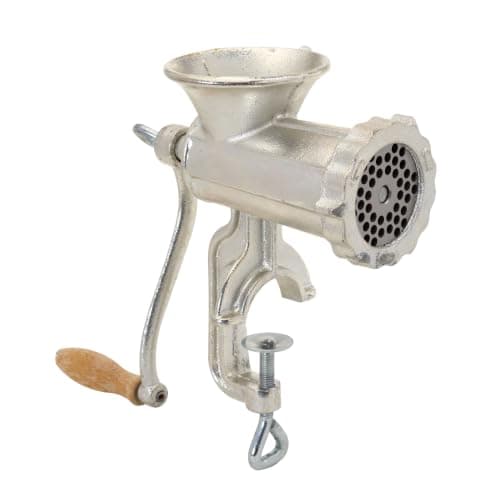
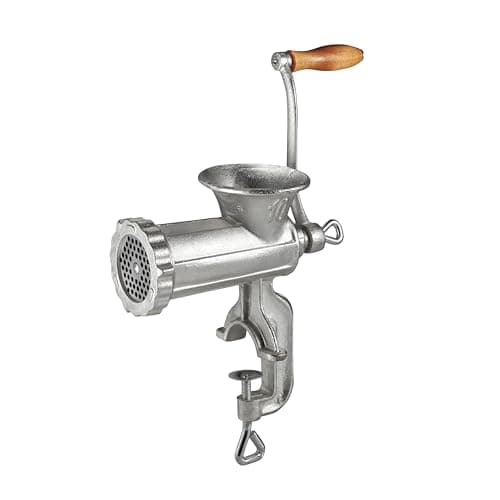
A hand grinder is only as good as the surface it grips. Check your table or counter lip before you order: LEM's stainless #10 and Weston's #10 clamp to surfaces up to 1-1/2 inches thick, LEM's cast #10 to 1-3/4 inches, and the VEVOR to 1.8 inches. Weston's #10 and the VEVOR include rubber pads to protect the surface.
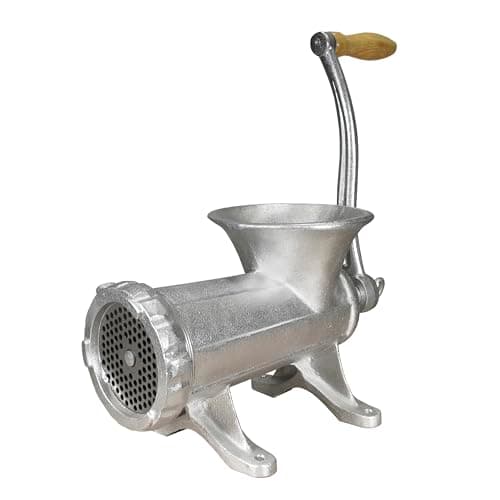
Hopper size decides how often you reload: Weston lists 3 x 4 inches on its #10 and 4 x 5 inches on its #22, and VEVOR a 3.35 inch inlet. The Weston #22 takes bigger bites per turn than any #10, which means more meat per crank and more effort per crank. Clamp it to something solid. Weston pitches it for use in the field, with no electricity needed.
On "made in USA": none of the maker pages or listings we cite claims US manufacture for these grinders. If that matters to you, check country of origin on the listing before you buy.
The five at a glance
Grinder
Body
Plates in the box
Clamp
Stuffing
Warranty
LEM #10 Stainless
Stainless steel
3/8 in. and 3/16 in.
Up to 1-1/2 in.
3 tubes, stuffing star
1 year
Weston #22 Manual
Tinned cast iron
Not stated on the listing
Adjustable
Kit included
Not stated
VEVOR Manual Stainless
Stainless steel
4.5 mm and 8 mm
Up to 1.8 in.
Stuffing tube
Not stated
LEM #10 Cast Iron
Tinned cast iron
8 mm
Up to 1-3/4 in.
None listed
1 year
Weston #10 Manual
Tinned
4.5 mm and 10 mm
Up to 1-1/2 in.
14, 19 and 24 mm funnels
Not stated
From the LEM stainless and LEM cast product pages and the Weston and VEVOR Amazon listings. Where a maker doesn't state something, we say so and score it neutral rather than guess.
Read across the rows and the ranking makes sense. The LEM stainless wins on build and on what's in the box: two plates for a coarse-then-fine grind, stuffing tubes, and a warranty from a maker that sells parts. The Weston #22 is the one for bigger batches because of its head and hopper. The VEVOR is the cheap way into stainless. The LEM cast iron is a bare-bones backup with one plate, and the Weston #10 is the best value if you want a sausage kit thrown in and don't mind a tinned finish.
In detail
The picks, in full
1
Best hand grinder
LEM #10 Stainless Steel Clamp-On Hand Grinder
5.9 /10
The hand grinder worth owning: stainless, 2-4 lb a minute by LEM's figure, two plates and stuffing tubes. The honest answer for one deer.
+Stainless: no tinning to wear through, and it cleans without the rust worry of cast iron
+Two plates for a coarse-then-fine grind, plus stuffing tubes
+Works without power: a cabin, a camp or a power outage
What it doesn't
−LEM says standard LEM grinder knives and plates will not fit it; buy parts made for this model
−Clamps only to surfaces up to 1-1/2 in. thick
−At 2-4 lb a minute, one deer is 13-26 minutes of cranking per pass
Skip this if…
…you process two or more deer. At 2-4 lb a minute a 2-deer season (about 104 lb) is 26-52 minutes of cranking per pass; LEM rates its BigBite #8 at 7 lb a minute, about 15.
#ad · Price as of Sep 19, 2026 · Affiliate disclosure for the link to Weston #10 Manual Tinned Meat Grinder and Sausage Stuffer
Getting the most from a hand grinder
A hand grinder punishes bad prep more than an electric does, because you feel every strand of sinew in the crank. The same habits that keep an electric from stalling make a manual grinder bearable:
Trim hard. Weston's grinder manuals say to trim off cords, tendons, bones and shot before grinding. Silver skin that wraps the knife is the main reason a hand grinder suddenly gets hard to turn.
Grind cold. Weston's manuals call for meat chilled to 32-34°F. KitchenAid's metal grinder manual goes further: very cold or partially frozen meat, and parts pre-chilled in the fridge or freezer. Cold fat cuts cleanly instead of smearing.
Cut to fit the throat. Strips or cubes that drop in without forcing keep the auger fed steadily.
Coarse first, then fine. Two quick passes are easier on your arm than one fine pass through tough meat.
Dry everything. Especially tinned cast iron: LEM says to dry it completely before storing.
LEM backs both of its #10s with a 1-year warranty and lifetime customer support, and says it carries replacement parts for past and present products. Weston and VEVOR don't state a warranty on the listings we cite, so we scored them neutral on that metric rather than guessing.
Stuffing by hand
LEM's stainless #10 includes three stuffing tubes and a stuffing star, and Weston's #10 and #22 come with sausage kits. That's fine for a few pounds of breakfast links. For a real sausage batch, a dedicated stuffer is faster and gets less air into the casing.
Storing it between seasons
A hand grinder can sit in a drawer for eleven months, which is exactly when rust finds it. Wash it in warm, soapy water, dry every part completely (LEM's instruction for its cast grinder), and store the knife and plates dry. One plate seller, BOLEXINO, suggests a small amount of vegetable oil on the plates to keep rust off. Before the next season, wash that off, check the knife edge, and if the grind has started to smear, replace the knife and plate together, which is LEM's advice for its own knives.
How we picked
Units we claim to have bench-tested: none
Plenty of sites say they ground two hundred pounds through every grinder. We didn't, and we say so. What we do instead: read the maker's spec sheet, manual and warranty terms, record the figures that decide whether a machine keeps up with your season (size number, motor rating, rated pounds per minute, capacity, duty cycle, gearing), check parts availability, and score each pick on a published rubric. Then we show the season math — pounds per deer from the Ohio Division of Wildlife's yield study — so you can redo it with your own numbers.
For one deer a season, yes. At LEM's rated 2-4 lb a minute, the Ohio DNR average of about 52 lb is 13-26 minutes of cranking per pass. At three or more deer, an electric grinder saves hours.
How long does it take to grind a deer by hand?+
About 13-26 minutes of cranking per pass for an average deer, using LEM's 2-4 lb a minute rating for its #10 hand grinders. Double it for a coarse-then-fine grind, and add time for trimming and chilling.
Is a stainless or cast iron hand grinder better?+
Stainless resists rust and tolerates less careful drying. Tinned cast iron is cheaper and heavy, but LEM's care instructions for its cast grinder say hand wash only and dry completely before storing.
Can a hand grinder stuff sausage?+
Yes, with the included tubes: LEM's stainless #10 ships with three tubes and a stuffing star, and Weston's #10 with 14, 19 and 24 mm funnels. It's slow for big batches; a dedicated stuffer is the better tool at volume.
Is there a manual meat grinder made in the USA?+
None of the maker pages or listings we cite for these five grinders claims US manufacture. Check the country of origin on the listing if it matters to you.
We haven't bench-tested this gear and we don't pretend to. Specs come from the maker's own pages, manuals and maker-supplied listing copy (labeled as such); food-safety figures from USDA and university extension publications; yield from the Ohio Division of Wildlife; prices live from Amazon. Where a figure isn't published, we say so. Read the full method.