Meat Grinder vs Food Processor: Why One Makes Burger and One Makes Paste
A food processor has more watts than most home grinders and costs about the same. It still cannot make venison burger, and the reason is mechanical rather than a matter of degree.
The best-documented food processor you can buy, and still the wrong tool for venison: it chops with a spinning blade instead of cutting with a plate and knife.
#ad · Price as of Sep 24, 2026 · Affiliate disclosure for the link to Cuisinart DFP-14BCNY 14-Cup Food Processor
A food processor cannot grind meat. It can chop it, and on lean venison full of silverskin and sinew what it actually produces is a smeared paste with strings of connective tissue wrapped around the blade post. This is not a question of power — the Cuisinart DFP-14BCNY has a 720-watt motor, more than the 500W LEM MightyBite #8 — it is a question of what the two machines physically do.
The mechanical difference, in one paragraph
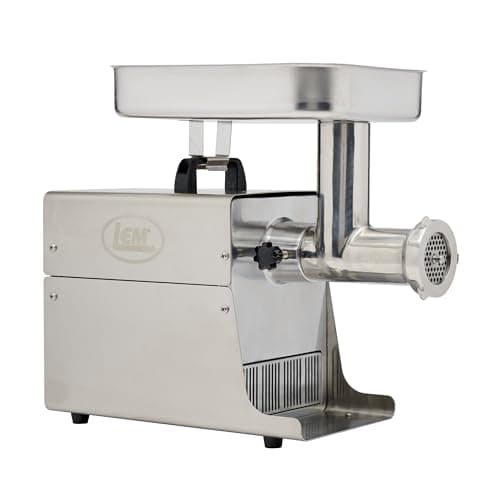
A grinder is a screw, a knife and a plate. An auger forces meat against a rotating knife that sits flush against a fixed plate; the meat is cut through by the knife and extruded through the holes. Every piece is cut once, to a size set by the plate. Connective tissue is either cut cleanly or stopped at the plate, where you can see it.
A food processor is a blade on a post. It spins fast in an open bowl and chops whatever it strikes. Nothing sets a size; nothing forces the meat through anything. Pieces near the blade get hit repeatedly and pieces at the edge of the bowl barely get hit at all, and the way you fix that is to run it longer — which over-processes the meat that was already done.
Meat grinder (LEM BigBite #8)
Food processor (Cuisinart DFP-14BCNY)
Cutting mechanism
Auger, rotating knife, fixed plate
S-blade spinning in an open bowl
Motor
See LEM's spec sheet for this model
720 watts
Grind size control
Yes — by plate (4.5 mm, 10 mm, stuffing plate)
None
Result is uniform?
Yes, every piece cut to plate size
No — over-chopped near the blade, coarse at the rim
What happens to sinew
Cut, or stopped visibly at the plate
Wraps the blade post
Can it stuff casings?
Yes, with the stuffing plate and tubes included
No
Published meat throughput
Yes, LEM publishes a rate
None — Cuisinart publishes no meat figure
Dishwasher-safe parts
No — hand wash the head
Yes
Warranty
Per LEM
3 years unit, 5 years motor
Two rows genuinely favour the processor: dishwasher-safe parts and that warranty. A 5-year motor warranty is better than anything in our grinder catalog. It is a well-made machine being asked to do something it was not built for.
Why venison specifically is the worst case
Beef chuck has intramuscular fat and relatively forgiving connective tissue. Venison is the opposite: very lean, and the muscles are wrapped in tough silverskin that runs in sheets. A plate-and-knife grinder cuts through those sheets or holds them at the plate. A spinning blade tears at them, and torn sheets wind around the blade post until the bowl stops moving.
There is also a temperature problem. A processor works meat for far longer to get anywhere near an even result, and the friction warms it. Warm fat smears instead of cutting — the same failure our clogging and mushing guide covers for grinders, arriving faster. If you are adding pork fat for a proper venison burger fat ratio, a processor is the machine most likely to turn that fat into a paste.
The one case the processor wins
Everything around the meat. A sausage or burger day involves onions, garlic, herbs, breadcrumbs and sometimes dough, and a 14-cup processor with a 4 mm slicing disc and a shredding disc is simply the right tool for all of it. The Cuisinart also goes in the dishwasher, which a grinder head does not.
So the honest answer to “grinder or processor” is that they are not competitors. If you own a processor and were hoping to skip buying a grinder, the answer is no. If you own a grinder and were wondering whether a processor is redundant, also no.
What to buy instead, if the budget is the problem
Usually the real question behind this comparison is money: the processor is already on the counter. Here is what the cheapest route to actual ground venison looks like:
Throughput and a published rate; a processor publishes no meat figure at all
You only want chili meat, never patties
Your processor, pulsed, or a knife
Nothing — this is the one job it does acceptably
A manual grinder or a stand-mixer attachment costs less than most food processors and does the thing a processor cannot. That is the whole recommendation. Our electric vs manual page picks up from there, and grinder sizes explained covers what the # numbers mean.
The verdict
Buy a grinder for meat and keep the processor for everything else. The mechanical difference is not a matter of watts: a plate and knife cut to a set size, and a spinning blade does not. On lean, sinewy venison that difference is the difference between burger and paste. The cheapest real grinder beats the best processor at this one job, and the best processor beats every grinder at the other six jobs on a sausage day.
In detail
The contenders, in full
Best for 1-2 deer
LEM BigBite #8 Electric Meat Grinder
7.5 /10
The honest 1-2 deer grinder: 0.5 HP, up to 7 lb a minute by LEM's figure, a stainless head and a 5-year warranty from a maker that stocks parts.
+7 lb a minute on LEM's figure: a 2-deer season (about 104 lb) is roughly 15 minutes of feeding per pass
+Stainless motor housing, knife and plates; stuffing tubes and stomper included
+5-year warranty, and LEM says it carries replacement parts for past and present models
What it doesn't
−No reverse function is listed on LEM's spec page, so a knife wrapped in silver skin means stopping and opening the head
−LEM's listing says it is not for bones
−At 3-5 deer you feed about 60% longer than on LEM's own #12 (7 vs 11 lb a minute)
Skip this if…
…you regularly process three or more deer or split beef with family. LEM rates its own #12 at about 11 lb a minute and its #22 at 13, against this one's 7.
#ad · Price as of Sep 24, 2026 · Affiliate disclosure for the link to LEM BigBite #8 Electric Meat Grinder
CuisinartNo image
If you already own one
Cuisinart DFP-14BCNY 14-Cup Food Processor
5.4 /10
The best-documented food processor you can buy, and still the wrong tool for venison: it chops with a spinning blade instead of cutting with a plate and knife.
#ad · Price as of Sep 24, 2026 · Affiliate disclosure for the link to Cuisinart DFP-14BCNY 14-Cup Food Processor
How we picked
Units we claim to have bench-tested: none
Plenty of sites say they ground two hundred pounds through every grinder. We didn't, and we say so. What we do instead: read the maker's spec sheet, manual and warranty terms, record the figures that decide whether a machine keeps up with your season (size number, motor rating, rated pounds per minute, capacity, duty cycle, gearing), check parts availability, and score each pick on a published rubric. Then we show the season math — pounds per deer from the Ohio Division of Wildlife's yield study — so you can redo it with your own numbers.
You can chop it. You cannot grind it. A grinder cuts meat with a rotating knife against a fixed plate, so every piece is cut once to a set size; a processor spins a blade in an open bowl with nothing setting the size. On venison the result is uneven and pasty, with sinew wrapped around the blade post.
Is a food processor strong enough to grind venison?+
Power is not the limit. The Cuisinart DFP-14BCNY has a 720-watt motor, more than the 500W LEM MightyBite #8 grinder. The limit is mechanical: there is no plate and no knife, so nothing sets the grind or cuts the silverskin.
What can you use instead of a meat grinder?+
A manual grinder or a stand-mixer grinder attachment — both have a real plate and knife and both cost less than most food processors. Hand-chopping with two knives also works for small amounts. A food processor is the one substitute that changes the result rather than just the speed.
Will a food processor ruin the texture of burger?+
For patties, yes. You get over-chopped paste near the blade and coarse chunks at the rim, and the extra working time warms the fat so it smears. For chili, a meat sauce or anything where texture is not the point, a pulsed processor is acceptable.
Should I buy a food processor or a meat grinder first?+
If you process deer, the grinder — it is the machine with no substitute. The processor is genuinely better than a grinder at everything else on a sausage day (onions, herbs, breadcrumbs, dough) and its parts go in the dishwasher, so it is worth owning second rather than instead.
We haven't bench-tested this gear and we don't pretend to. Specs come from the maker's own pages, manuals and maker-supplied listing copy (labeled as such); food-safety figures from USDA and university extension publications; yield from the Ohio Division of Wildlife; prices live from Amazon. Where a figure isn't published, we say so. Read the full method.