Under $100 you are arguing about peak wattage. Two hundred dollars is the band where makers start publishing a rated output you can plan a deer around - and where a stainless detachable head stops being optional.
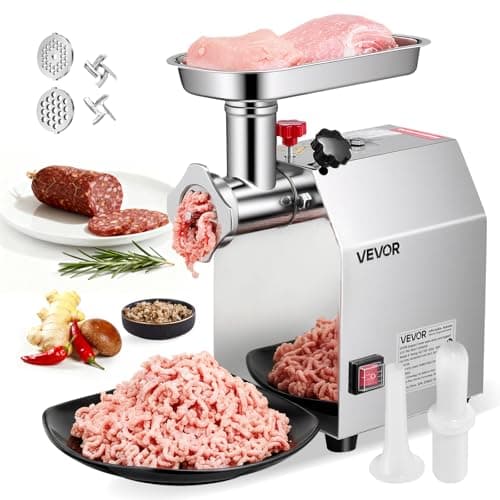
A published 300 lb an hour on a 600 W motor, in food-grade stainless with a detachable head, a waterproof switch and reverse. The most rated output per dollar in the band.
A published 300 lb an hour on a 600 W motor, in food-grade stainless with a detachable head, a waterproof switch and reverse. The most rated output per dollar in the band.
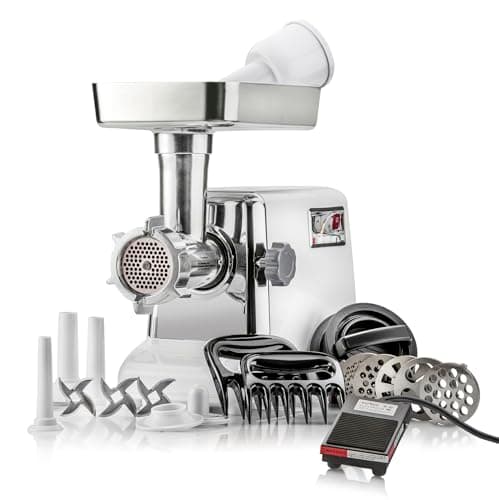
A #12 head and the only listing in the band that prints both numbers: 3000 W locked-motor against 800-1200 W under real load. Three-year warranty and a foot pedal in the box.
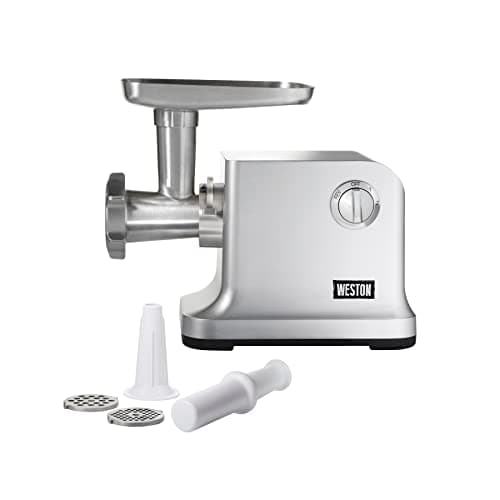
750 W, 1 HP and 4-5 lb a minute, with metal gears, two speeds and reverse in a die-cast body. Weston asks for a rest after five minutes, which is the catch.
#ad · Prices come live from Amazon, last checked November 19, 2026; where we have no verified live price we show none. Scores are ours on a published 8.4-9.8 scale, compiled from manufacturer specs, manuals and warranty terms — see how we pick. Tap a row for the full write-up.
The best meat grinder under $200 is the VEVOR Commercial #8. VEVOR publishes a rated output — approximately 300 pounds an hour on a 600 W motor — and builds it in food-grade stainless with a detachable head, a waterproof switch and a reverse function. A published rate and a head you can pull off and wash are the two things this band buys that the band below it does not.
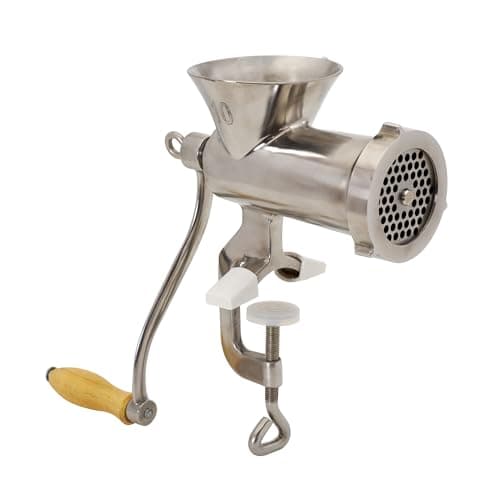
If you want the most honest spec sheet, take the STX Turboforce 3000 with the foot pedal. It is the only listing here that prints both wattage numbers — 3000 W locked-motor against 800–1200 W under real load — and it carries a three-year warranty. If you would rather not own a motor at all, the LEM #10 stainless hand grinder is rated at 2–4 pounds a minute and has nothing in it to burn out.
Six grinders, ranked on what the makers actually publish. Every figure below is the maker's own number from the product page, manual or listing cited under Sources.
What $200 buys that $100 does not
Our under $100 page makes one argument at length: in the cheap band almost nobody publishes a rated wattage, so you are comparing peak numbers that describe a motor at the instant it stalls. Doubling the budget changes that. Three specific things appear:
A rated output you can plan around. Pounds per minute or pounds per hour, published by the maker. Four of the six picks here have one.
A detachable stainless head. Grinder cleanup is the job that decides whether you keep using the machine, and a head that comes off and goes in the sink is a different experience from one that does not.
Reverse. Silver skin wraps the knife. Without a reverse function that means stopping, opening the head and clearing it by hand, which on a deer happens more than once.
What $200 does not buy is a #22 electric head or an all-metal gearbox rated for a season of back-to back grinding. That is the band above, and if a 3-5 deer season is the plan, the honest page to read is the best meat grinders for deer rather than this one.
What we ranked on
Published rated output (30%). A stated pounds-per-minute or pounds-per-hour figure, from the maker. A peak-wattage claim with no rated figure beside it scores nothing here.
Build and head size (25%). Head number, stainless against aluminum against tinned cast iron, metal gears, and whether the head detaches for cleaning.
Venison handling (20%). Reverse, plate selection and whether the maker says anything about sinew and silver skin.
Cleanup (15%). What comes apart, what is dishwasher safe and what the maker says about water temperature.
Value at the live price (10%). Read from the price pipeline at the last refresh and shown on the button, never typed here.
These are the hub's standard grinder weights — see how we pick.
Rated output, not peak wattage
The single most useful habit in this category is to ignore the biggest number on the box. A grinder listing that shouts “3000 W” is usually quoting locked-motor wattage: the draw at the instant the motor is stalled and about to trip. It is a real measurement of a situation you never want to be in.
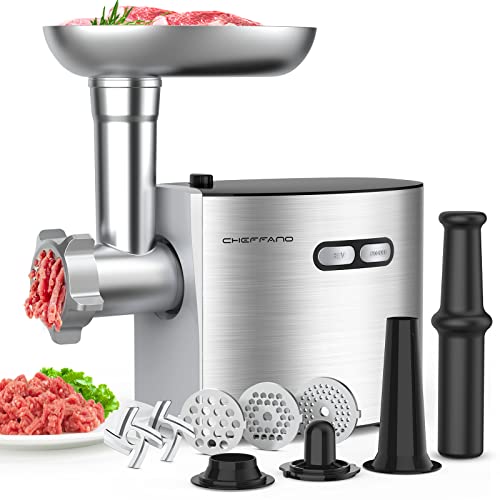
Two machines here handle that honestly and both are better for it. STX prints the locked figure and the working range — 3000 W locked against 800–1200 W under load. CHEFFANO prints 350 W rated next to a 2800 W peak, which is the only place in the cheap end of this band you will see both numbers together. Knowing the real figure is roughly an eighth of the headline is worth more than the headline.
Grinder
Head
Published rate
Motor, as published
VEVOR Commercial #8
#8
~300 lb/hour
600 W
STX Turboforce 3000
#12
Not stated
800-1200 W under load (3000 W locked)
LEM #10 hand
#10
2-4 lb/min
You
Weston #12 electric
#12
4-5 lb/min
750 W, 1 HP
Weston #22 manual
#22
Not stated
You
CHEFFANO electric
Not stated
~3 lb/min
350 W rated (2800 W peak)
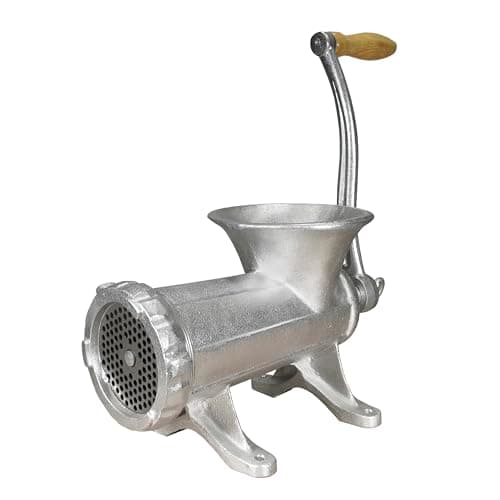
Note the row that cuts against the ranking: the Weston #22 manual has the largest head on the page by a wide margin and publishes no rate at all, because the rate is however fast you turn the handle. Head size and rated output are separate questions and the listings blur them. Our grinder sizes explained page sets out what the number actually means.
What the ratings mean in deer
The Ohio Division of Wildlife weighed 115 field-dressed whitetails and recorded an average of 52.19 lb of venison per deer once butchered. Most of that does not go through the grinder — steaks and roasts come off whole — but on a boned-out deer destined mostly for burger and sausage, the whole yield is a fair worst case. Here is what the published rates mean against it:
That arithmetic is the honest case against overspending in this band. If you process one or two deer a year, the difference between a 3 lb/min machine and a 5 lb/min machine is under half an hour a season. What you should actually buy on is the thing that makes you stop: a jam you cannot clear, or a head you dread washing.
The rest intervals nobody reads
Every electric in this band has a duty limit, and the makers publish them where you will not look — in the manual rather than on the listing. Weston asks for no more than five minutes of continuous running on the #12 before a rest. STX says to let the Turboforce cool for a few minutes after 10–15 minutes of continual use.
Those are not defects; they are honest statements about small motors, and they are exactly the numbers you need to plan a processing day. A five-minute limit on a 13-minute deer means working in stages with rests, not one continuous run. It is also the clearest argument for the hand grinder on this page: a crank has no duty cycle at all.
If your grinder is stopping for a different reason, the usual culprit is warmth and sinew rather than the motor — why a grinder keeps clogging works through the fixes, and partly freezing the trim is the one that does most of the work.
What the warranties tell you
Warranty length is the closest thing this band has to a maker's own confidence rating, and the spread is wider than the price spread. STX covers the Turboforce 3000 for three years. Weston and LEM both publish one year on the machines here, with LEM adding lifetime product support on top of it — a different promise from a warranty, but a real one if you ever need a part for a grinder you have owned for a decade.
Read those terms alongside the duty limits rather than separately. A three-year warranty on a motor the maker asks you to rest after fifteen minutes is a coherent position: the company expects the machine to last, under the conditions it published. A long warranty paired with no stated duty cycle at all tells you less, because nothing defines what counts as normal use.
The hand grinders sidestep this entirely. There is no motor to fail, and the failure modes that remain — a stripped clamp thread, a worn knife — are mechanical, visible and usually fixable. That is worth weighing if you expect to own the thing for twenty seasons rather than two, and it is a large part of why a crank ranks this high on a page otherwise dominated by electrics.
The case for a hand grinder
Two of the six picks here have no motor, and that is not a budget compromise. A clamp-on hand grinder has no duty cycle, nothing to burn out, and in the LEM's case a published 2–4 pounds a minute, which is inside the range of the electrics on this page. It will still be working in twenty years.
The honest limits: it needs a counter edge it can clamp to, it is one-handed work with the other hand feeding, and for anything past a deer or two a season the cranking stops being charming. The manual grinder rankings cover the class properly, and electric vs manual settles which side of the line you are on before you spend anything.
In detail
The picks, in full
1
Best under $200
VEVOR Commercial #8 Electric Meat Grinder (600 W)
8.9 /10
A published 300 lb an hour on a 600 W motor, in food-grade stainless with a detachable head, a waterproof switch and reverse. The most rated output per dollar in the band.
#ad · Price as of November 19, 2026 · Affiliate disclosure for the link to VEVOR Commercial #8 Electric Meat Grinder (600 W)
2
Most honest spec sheet
STX Turboforce 3000 Electric Meat Grinder with Foot Pedal (#12)
8.9 /10
A #12 head and the only listing in the band that prints both numbers: 3000 W locked-motor against 800-1200 W under real load. Three-year warranty and a foot pedal in the box.
Rubric inputs — criteria out of 10, weighted into the score above
Season throughput
4 · 30%
Build
8 · 20%
Venison handling
4 · 15%
Cleanup
8 · 10%
Parts & warranty
6.5 · 15%
Value
7 · 10%
What it gets right
+Stainless: no tinning to wear through, and it cleans without the rust worry of cast iron
+Two plates for a coarse-then-fine grind, plus stuffing tubes
+Works without power: a cabin, a camp or a power outage
Good to know
−LEM says standard LEM grinder knives and plates will not fit it; buy parts made for this model
−Clamps only to surfaces up to 1-1/2 in. thick
−At 2-4 lb a minute, one deer is 13-26 minutes of cranking per pass
Skip this if…
…you process two or more deer. At 2-4 lb a minute a 2-deer season (about 104 lb) is 26-52 minutes of cranking per pass; LEM rates its BigBite #8 at 7 lb a minute, about 15.
#ad · Price as of November 19, 2026 · Affiliate disclosure for the link to LEM #10 Stainless Steel Clamp-On Hand Grinder
4
Best #12 head in the band
Weston #12 Electric Meat Grinder & Sausage Stuffer
8.8 /10
750 W, 1 HP and 4-5 lb a minute, with metal gears, two speeds and reverse in a die-cast body. Weston asks for a rest after five minutes, which is the catch.
Rubric inputs — criteria out of 10, weighted into the score above
Season throughput
4.5 · 30%
Build
6 · 20%
Venison handling
6.5 · 15%
Cleanup
6 · 10%
Parts & warranty
5 · 15%
Value
8 · 10%
What it gets right
+Reverse and a slow speed for stuffing, per Weston's listing
+Metal gears in a compact aluminum body
+Cam-action headlock makes the head quick to take off for cleaning
Good to know
−The 5-minute run limit means roughly 20-25 lb per run at its rated speed, then a rest
−One-year warranty, the shortest of the electrics here
−Weston's manual says not to grind bones or other hard items
Skip this if…
…you grind a whole deer at a sitting. At 20-25 lb per 5-minute run, a 2-deer season (about 104 lb) is five or six separate runs per pass, with a rest after each.
#ad · Price as of November 19, 2026 · Affiliate disclosure for the link to CHEFFANO Electric Meat Grinder (ETL Approved)
How to choose inside the band
Start with the season, not the budget. One or two deer: anything on this page does it, so buy on cleanup and reverse rather than on rate. Three or more, or a half beef in the mix: this band is the wrong band, and the honest move is to save for a #12 or #22 with metal gears rather than buy twice.
Then insist on a published rate. Four of these six have one. A listing that quotes only a peak wattage is telling you about a stall, not about work.
Then check what comes off for washing. A detachable stainless head is the difference between a ten-minute cleanup and a machine that quietly stops getting used. Note that several bodies here are hand-wash only and at least one maker specifies a water temperature.
Then look for reverse. Three picks here have it. Silver skin wrapping the knife is the most common stoppage on venison, and reverse clears it without opening the head.
Budget for plates, not just the machine
Grinders in this band ship with two or three plates, which is enough to start and not enough to finish. A coarse plate for the first pass and a fine plate for the second is the standard burger routine, and snack sticks want finer still. Plates and knives are cheap next to the machine and wear as a matched pair — our plates and knives rankings cover which sizes do what, and grinder plate sizes explains the numbering before you buy the wrong fit.
If sausage is the real goal rather than burger, note that two picks here include a stuffing kit. That is a genuine saving, with the caveat that stuffing through a grinder head is slower and warmer than using a dedicated stuffer — stuffer vs grinder tubes is the page that settles it. Either way the casing is a separate purchase and the sizes are not interchangeable — best sausage casings maps diameter to what you are actually making.
A published 300 lb an hour on a 600 W motor, in food-grade stainless with a detachable head, a waterproof switch and reverse. The most rated output per dollar in the band.
A #12 head and the only listing in the band that prints both numbers: 3000 W locked-motor against 800-1200 W under real load. Three-year warranty and a foot pedal in the box.
#ad · Price as of November 19, 2026 · Affiliate disclosure for the link to STX Turboforce 3000 Electric Meat Grinder with Foot Pedal (#12)
How we picked
Every pick, scored on the same published rubric
Each machine here is read end to end: the maker's spec sheet, the owner's manual and the warranty terms. We pull out the figures that decide whether it keeps up with your season — size number, motor rating, rated pounds per minute, capacity, duty cycle, gearing — confirm parts are still available, and score every pick on the same weighted rubric, so a score on one page means the same thing on the next. Then we show the season math, pounds per deer from the Ohio Division of Wildlife's yield study, so you can run it against your own freezer.
The VEVOR Commercial #8. It publishes a rated output of approximately 300 lb an hour on a 600 W motor, and builds it in food-grade stainless with a detachable head, a waterproof switch and reverse.
Is a $200 meat grinder better than a $100 one?+
For planning, yes: this band is where makers start publishing a rated output instead of a peak wattage, and where a detachable stainless head and a reverse function become normal. For raw speed on one deer a year, the difference is under half an hour a season.
What does 3000 watts mean on a meat grinder?+
Usually locked-motor wattage — the draw at the instant the motor stalls, not the power it works at. STX is unusually clear about this, printing 3000 W locked alongside 800-1200 W under real load. Compare rated figures, not peak ones.
How long does it take to grind a deer?+
At the Ohio DNR average of 52.19 lb of venison per deer, a 4-5 lb/min machine is about 10-13 minutes of feeding per pass, and most people grind twice. The electrics here also have published rest intervals — five minutes continuous on the Weston, 10-15 on the STX — so a deer is a staged job rather than one run.
Can a hand grinder keep up with an electric?+
In this band, close to it. LEM rates its #10 stainless hand grinder at 2-4 lb a minute, which overlaps the electrics on this page, and a crank has no duty cycle to respect. What it costs you is the cranking, and past a deer or two a season that is a real cost.
Do I need a grinder with reverse?+
For venison it earns its place. Silver skin wraps the knife, and without reverse that means stopping and opening the head to clear it. Trimming sinew out properly and partly freezing the meat first reduces how often it happens.
Specs come from the maker's own pages, manuals and maker-supplied listing copy (labeled as such); food-safety figures from USDA and university extension publications; yield from the Ohio Division of Wildlife; prices live from Amazon. Where a figure isn't published, we say so. Read the full method.