Home Processing ◆ Guide
How Much Meat Do You Get From an Elk? About 218 lb From a Bull, 169 From a Cow
Those are measured numbers from six bulls and six cows processed for a University of Wyoming bulletin, not estimates - and they are roughly four deer's worth of meat arriving in one afternoon.
We earn a commission if you buy through our links, at no extra cost to you. It never decides the ranking — the method is published · Affiliate disclosure
A bull elk yields about 218 lb of boneless meat and a cow about 169 lb. Those figures come from the University of Wyoming Agricultural Experiment Station's elk bulletin, which processed 6 bulls averaging 437 lb field dressed and 6 cows averaging 339 lb. The rule of thumb behind both: “The boneless lean yield averaged 50 percent of the field-dressed weight.”
Across every elk harvested in Wyoming including calves, the bulletin's weighted average works out to 328.2 lb field dressed, “which can be converted to 164.1 pounds of boneless elk.” If you want one number to plan around, that is the honest one.
The measured numbers
| Measurement | Bulls (n=6) | Cows (n=6) |
|---|---|---|
| Field-dressed weight | 437 lb | 339 lb |
| Head | 39 lb | 19 lb |
| Skin | 34 lb | 26 lb |
| Boneless lean | 218 lb | 169 lb |
One footnote in the bulletin is worth reading before you quote those totals: the boneless figures include 17.7 lb of boneless lean from the brisket, plate and flank of bulls and 18.6 lb from cows, cuts the bulletin notes “are sometimes discarded because of contamination.” If you trim those away, take about 18 lb off.
The field-dressed weight in that table is the eviscerated carcass with head and hide still attached, legs cut off at the knees and hocks. That is the number most hunters actually weigh, which is why it is the useful basis.
Working it out from a weight you know
The bulletin publishes a conversion table for bull elk that lets you start from whichever weight you have:
| Weight | Example | Factor |
|---|---|---|
| Whole weight | 568 lb | 1.42 x field-dressed weight |
| Field-dressed (viscera and feet removed) | 400 lb | 0.70 x whole weight |
| Skinned carcass (skin and head removed) | 332 lb | 0.83 x field-dressed weight |
| Boneless lean | 166 lb | 0.50 x field-dressed weight |
The bulletin notes that whole weight stands in for live weight and is slightly less, because it does not include blood loss at harvest. So the quick arithmetic is: halve the field-dressed weight for boneless meat, or take about 35 percent of the whole weight.
Why your processor's number comes out lower
That seven-point gap is the single most useful thing in the bulletin for a hunter who processes their own. Shot placement and cleanliness are worth about 30 lb of meat on a bull. Penn State Extension's guidance on processing wild game makes the same point from the food-safety side: trim damaged tissue away, and keep the carcass clean and cold through the whole job.
If you are paying a processor and the return looks light, 43 percent of field-dressed weight is the benchmark to measure against, not 50.
Yield by age class
The bulletin also tabulates average field-dressed weight and boneless meat by age, which is how a cow tag and a mature bull tag turn into very different afternoons:
| Age class | Male: field dressed / boneless | Female: field dressed / boneless |
|---|---|---|
| Calves | 184 lb / 92 lb | 176 lb / 88 lb |
| 1.5 years | 280 lb / 140 lb | 244 lb / 122 lb |
| 2.5 years | 337 lb / 168 lb | 304 lb / 152 lb |
| 3.5 to 4.5 years | 400 lb / 200 lb | 329 lb / 164 lb |
| 5.5 to 6.5 years | 504 lb / 252 lb | 359 lb / 179 lb |
Freezer space for an elk
This is where the number stops being trivia. Using the Good Meat Project's packing range — about 30 lb per perfectly packed cubic foot, with 20 to 25 lb more realistic — here is what each animal asks of a freezer:
| Animal | Boneless meat | Cubic feet at realistic packing |
|---|---|---|
| Cow elk | 169 lb | 6.8 to 8.5 cu ft |
| Bull elk | 218 lb | 8.7 to 10.9 cu ft |
| Mature 5.5-6.5 year bull | 252 lb | 10.1 to 12.6 cu ft |
| Weighted average, all Wyoming elk | 164.1 lb | 6.6 to 8.2 cu ft |
So one bull elk wants something in the 9 to 11 cubic foot class on its own — before the deer, before the half hog, before the berries. A 5 or 7 cubic foot chest freezer does not take a bull elk. NDSU's freezing guidance adds the loading rule that goes with it: freeze in shallow packages, spread them in one layer rather than stacking, and only stack once they are frozen solid. Our best chest freezers for meat page and freezer space for a deer work the sizing through.
What an elk does to your grinder choice
An elk is not a bigger deer; it is four deer arriving at once. If a quarter of a bull goes to grind, that is over fifty pounds of trim in one session, and blended to 80/20 and ground twice it is well over a hundred pounds through the head. On a #8 rated at 4 to 7 lb a minute that is a long afternoon of feeding. On a #22 at 13 to 14 lb a minute it is a job.
The bulletin also notes something that bears directly on grinding: an elk carcass contains about the same amount of collagen (connective tissue) as beef and lamb, but more connective tissue than antelope or deer. Connective tissue is exactly what wraps a grinder knife, which is the argument for trimming hard and for valuing a reverse function. Our clogging guide covers the technique, and commercial-grade grinders covers the tier above a #22 if elk is an annual event rather than a once.
Picks for this job
Sized for an elk, not a deer
A #22 head and a freezer with room for 160 to 220 lb of boneless meat. Both are a size up from what a deer season needs.
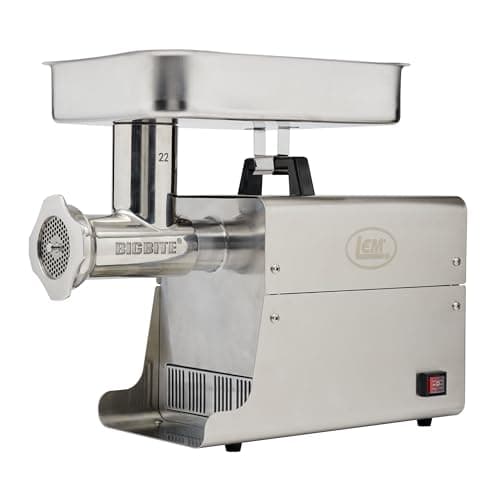
Best for 6+ deer
LEM BigBite #22 Electric Meat Grinder (1 HP)
A #22 at 13 lb a minute, with LEM's 5-year warranty and a stocked parts catalogue - the sensible grinder for an animal that arrives with 50 lb of trim.
Check price · Amazon#ad · Price as of November 4, 2026 · Affiliate disclosure for the link to LEM BigBite #22 Electric Meat Grinder (1 HP)
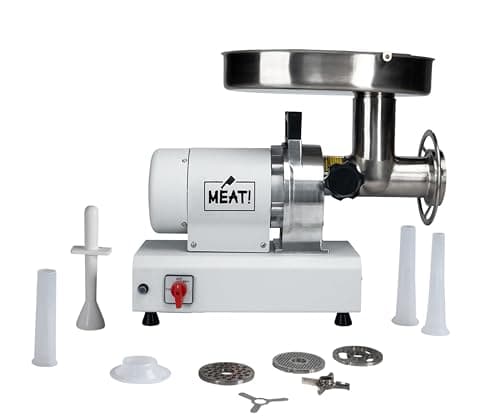
Best #22 warranty, 6+ deer
MEAT! Your Maker #22 Pro-Grade Meat Grinder (1 HP)
The alternative #22: 1 HP, 11 to 14 lb a minute, all stainless, with MEAT!'s lifetime warranty to the original owner.
$454.99Amazon#ad · Price as of November 4, 2026 · Affiliate disclosure for the link to MEAT! Your Maker #22 Pro-Grade Meat Grinder (1 HP)
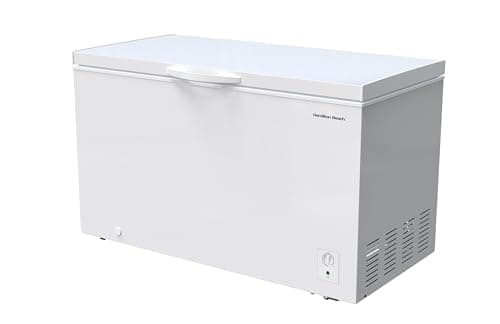
Best for 5-6 deer
Hamilton Beach 14 Cu. Ft. Chest Freezer (HBFRF1497)
A 14 cu ft chest freezer - enough for a bull elk's 9 to 11 cu ft with room left for the rest of the year.
$694.75Amazon#ad · Price as of November 4, 2026 · Affiliate disclosure for the link to Hamilton Beach 14 Cu. Ft. Chest Freezer (HBFRF1497)
An elk in deer terms
One comparison makes the whole thing concrete. At the Ohio DNR average of 52.19 lb of venison per whitetail, a bull elk at 218 lb of boneless meat is roughly 4 deer, and a cow at 169 lb is about 3. So a single elk tag turns a light season into a heavy one overnight, and every piece of gear should be sized accordingly — the grinder, the freezer, the number of lugs on the bench and the quantity of vacuum bags on the shelf.
If you are planning the whole chain around that, start from the 6+ deer setup, which is the closest season tier to one bull elk, and how much meat from a deer for the whitetail numbers this comparison rests on.
Questions
Frequently asked
How much meat do you get from an elk?
What percentage of an elk is edible meat?
How much freezer space does an elk need?
How many deer is an elk worth in meat?
What size meat grinder do you need for elk?
How heavy is a field-dressed bull elk?
Keep going down the chain
Related
Receipts
Sources
- University of Wyoming Agricultural Experiment Station, Bulletin B-594R (August 2003) — elk carcass care, boneless meat yield and weight conversion tables [PDF]
- Ohio Department of Natural Resources, Division of Wildlife — Venison Meat Yield (115 deer, 2017 gun season) [PDF]
- Good Meat Project — Freezer Space (pounds of meat per cubic foot)
- NDSU Extension (FN614) — Food Freezing Basics: Packaging, Loading the Freezer and Refreezing
- Penn State Extension — Proper Processing of Wild Game and Fish (updated June 2023)
- National Center for Home Food Preservation (University of Georgia) — Freezing Meats
- LEM Products — #22 BigBite Meat Grinder, 1 HP (product page, SKU 1781)
- LEM Products — #32 BigBite Meat Grinder, 1.5 HP (product page, SKU 1782)
- Amazon listing, manufacturer-supplied copy — LEM BigBite #22 (17811)
- Amazon listing, manufacturer-supplied copy — MEAT! #22 Pro-Grade grinder (1159179)
- Amazon listing, manufacturer-supplied copy — Hamilton Beach HBFRF1497 14 cu ft chest freezer
Specs come from the maker's own pages, manuals and maker-supplied listing copy (labeled as such); food-safety figures from USDA and university extension publications; yield from the Ohio Division of Wildlife; prices live from Amazon. Where a figure isn't published, we say so. Read the full method.