Vacuum Sealer Rolls vs Bags: Which One Your Season Actually Needs
Rolls are cheaper per package and fit a backstrap. Pre-cut bags are twice as fast and use half the seals. The right answer is set by your machine, your cuts and how long your processing day already is.
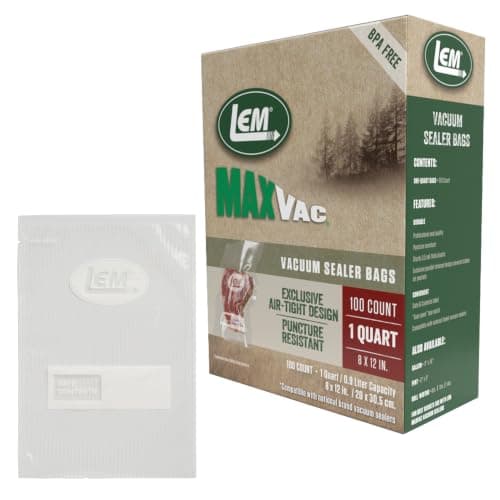
#ad · Price as of November 6, 2026 · Affiliate disclosure for the link to LEM MaxVac Quart Vacuum Sealer Bags, 8 x 12 in., 100-Count
Buy rolls if your cuts vary in size and you care about cost per package. Buy pre-cut bags if your packages are uniform and you care about getting the day finished. That is the whole decision in one line, and for most people processing venison the honest answer is both — pre-cut quart bags for the burger and the steaks, a roll for the backstraps, roasts and anything that will not fit a stock size.
What follows is why, with the one constraint that overrules all of it first: some machines cannot use some formats at all.
Your machine decides first
Before cost or convenience, check what your sealer can physically seal. This catches people out and it is not a preference, it is a hard compatibility wall.
Your sealer
Rolls
Pre-cut bags
External suction (FoodSaver, Weston, LEM MaxVac)
Yes — embossed/channel rolls only
Yes — embossed/channel bags only
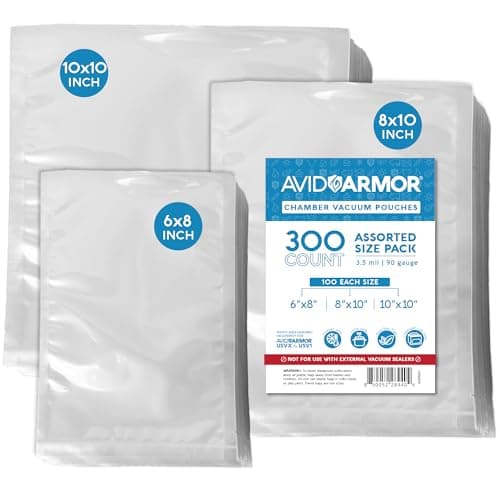
Chamber (Avid Armor, VEVOR DZ-260A)
Not the normal way to use one
Yes — smooth chamber pouches
The trap runs in both directions. A smooth chamber pouch will not work in an external suction sealer — Avid Armor says so on its own pouches — because an external machine needs the embossed channels to give the air a path out. And embossed bags in a chamber machine work but waste money, since you are paying for a texture the chamber does not need.
So: if you run a chamber sealer, this comparison is mostly settled for you. Smooth pouches, pre-cut, in assorted sizes. If you run an external suction machine — which is most people — read on, because both formats are genuinely open to you. Our chamber vs external page covers which machine to own in the first place.
The seal count nobody mentions
This is the argument for pre-cut bags, and it is the one that gets left out of every comparison we have read.
A pre-cut bag needs one seal. A bag cut from a roll needs two — one to close the bottom before you fill it, one to close the top after the vacuum. That doubles the number of heat cycles your machine performs, and on an external sealer heat is the limiting factor, not vacuum.
It also halves how far a published duty cycle goes. LEM rates the MaxVac 500 at 500 consecutive seals; that is about ten deer in pre-cut bags, or five off a roll. If your machine has a thermal cut-out — Weston's Pro-2300 shuts down for about 20 minutes when it overheats — the roll is the format that will find it.
Cost per package
And this is the argument for rolls. We will not type a price into this paragraph, because the numbers on the buy buttons below are live and these change constantly — but the structural point does not move: a roll is sold by the foot and a bag is sold by the unit, and the foot is almost always cheaper once you account for how much bag you actually need.
The reason is waste. A pre-cut quart bag is 8 by 12 inches whether the package inside it is a pound of burger or half that. Off a roll you cut to the piece, so a small package consumes less material. Over a season of mixed cuts that compounds.
The counter-argument is that your time has value too. If cutting, sealing the bottom, filling, and sealing the top takes you 25 seconds a package against 12 for a pre-cut bag, a 52-package deer costs you roughly 11 extra minutes. Whether that is worth the savings is a genuinely personal call, and it is the reason we recommend running both.
Here is where rolls stop being a cost decision and start being the only option.
A whole venison backstrap is long. So is a rolled roast, a rack of ribs, a whole fish, a dry-aging subprimal. None of those fit an 8 by 12 inch quart bag, and cutting a backstrap in half to make it fit a bag is a sad way to lose a cut. A roll gives you unlimited length within the width you bought — 11 inches of width and as many feet as the piece needs.
That is why the standard advice on this site is that a roll is not your main format, it is your other format. Burger, steaks, cubed stew meat and ground jerky mix all go in pre-cut bags at one seal each. The handful of long pieces come off the roll. One deer might be forty pre-cut bags and four roll-cut bags.
Width is the one thing a roll will not fix. Your seal bar caps it: an 11-inch bar takes an 11-inch roll and no more. If you regularly seal genuinely wide things, that is a machine decision, not a bag decision — see the Weston Pro-2300 review for the 15-inch bar case.
What width to buy
If you settle on rolls, width is the next decision and it is the one people get wrong, because the instinct is to buy the widest roll the machine takes and cut everything from it. That wastes material on every small package.
Eight inches and eleven inches are the two standard widths, and they do different jobs:
8 inch — burger, steaks, cubed stew meat, jerky strips, anything that would otherwise go in a quart bag. This is the width you will use most.
11 inch — backstraps, rolled roasts, rib racks, whole fish, dry-aging subprimals. The width you need occasionally and cannot substitute when you do.
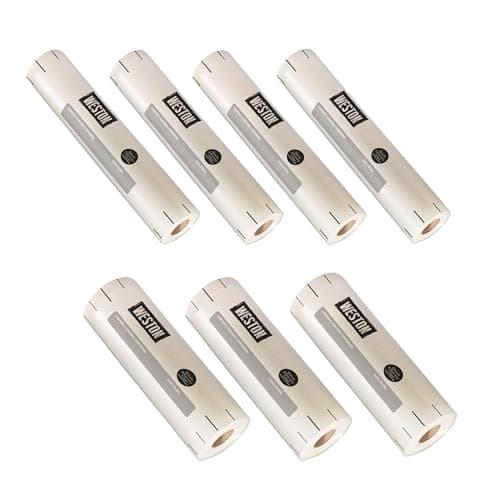
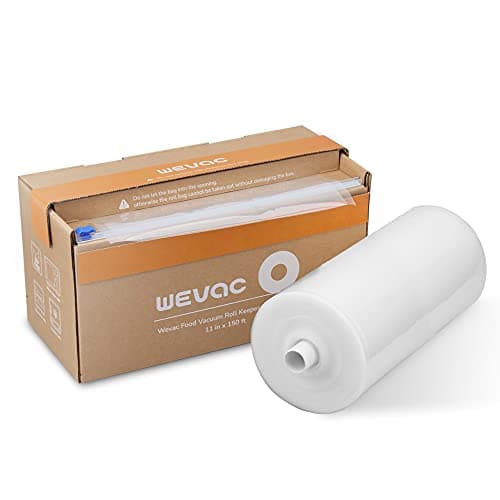
That is why a multi-roll pack that includes both widths is a genuinely sensible first purchase rather than a marketing bundle — Weston's 7-pack, for instance, ships three 8 in. x 20 ft rolls and four 11 in. x 16 ft rolls, which is roughly the ratio a season actually uses. A single 11-inch roll is the simpler buy, and the Wevac 150-footer is a lot of bag for the money, but you will be trimming width off most packages.
One hard limit: your seal bar caps roll width and nothing works around it. An 11-inch bar takes an 11-inch roll, full stop. Check the bar before you buy a roll wider than the machine.
Mil, and why the numbers disagree
Thickness is quoted in mils (thousandths of an inch) and it is the spec most worth checking, because it is what stands between a bone-in package and a punctured bag in month eight.
Product
Format
Published thickness
Wevac 11 in. x 150 ft
Roll, embossed
Not stated for the 11 in. roll; Wevac lists its 8 in. cutter roll at 3 mil
Weston rolls, 7-pack
Rolls, embossed
2-ply, 3 mil
LEM MaxVac quart bags
Pre-cut, embossed
3.14 mil on LEM's page; 3.4-3.5 mil in the Amazon copy
Avid Armor chamber pouches
Pre-cut, smooth
3.5 mil (90 gauge)
Two honest observations. First, the LEM figure contradicts itself across LEM's own product page and the Amazon listing copy for the same bags — 3.14 against 3.4-3.5 mil. We publish both rather than pick the flattering one. Second, Wevac does not state a thickness for the 11-inch roll at all; the 3 mil figure belongs to a different roll in the same line. Treat an unstated mil as unknown, not as 3.
For context: 3 mil is the normal floor for freezer use, and the chamber pouches at 3.5 mil are the thickest thing on this page. If you package bone-in, thickness matters more than format. If everything you freeze is boneless and trimmed, 3 mil is fine and you can buy on price.
What we would buy
External suction sealer, mixed cuts, one to five deer: a 100-count box of pre-cut quart bags as the workhorse, plus one 11-inch roll for the long pieces. One seal on nine packages out of ten, and nothing gets cut down to fit a bag.
External suction sealer, two widths, want one purchase: a multi-roll pack that includes both 8-inch and 11-inch rolls covers small and large off the same box, at the cost of two seals per package.
Chamber sealer: smooth pouches, assorted sizes, and ignore everything above about rolls. The format question does not apply to you; the chamber sealer roundup is the page you want.
Whatever you choose, the packaging itself is only half the job — the USDA's position is that freezing keeps food safe indefinitely and that packaging protects quality, not safety. Getting the air off the surface is what stops freezer burn, and the technique that does that is in how to package deer meat for the freezer. If your bags are coming out wet and failing at the seal, that is a different problem with a different fix: how to vacuum seal wet meat.
In detail
The contenders, in full
The roll case
Wevac Vacuum Sealer Roll, 11 in. x 150 ft
9.3 /10
One 150-foot embossed roll in a cutter box: about 150 twelve-inch bags, cut to whatever length the cut needs.
#ad · Price as of November 6, 2026 · Affiliate disclosure for the link to LEM MaxVac Quart Vacuum Sealer Bags, 8 x 12 in., 100-Count
How we picked
Every pick, scored on the same published rubric
Each machine here is read end to end: the maker's spec sheet, the owner's manual and the warranty terms. We pull out the figures that decide whether it keeps up with your season — size number, motor rating, rated pounds per minute, capacity, duty cycle, gearing — confirm parts are still available, and score every pick on the same weighted rubric, so a score on one page means the same thing on the next. Then we show the season math, pounds per deer from the Ohio Division of Wildlife's yield study, so you can run it against your own freezer.
Per package, usually yes — a roll is sold by the foot and you cut to the piece, so small packages use less material, where a pre-cut bag is one fixed size regardless of what goes in it. The trade is time and seals: a roll-cut bag needs two seals instead of one.
Can I use rolls in a chamber vacuum sealer?+
Not in the normal way. Chamber machines use smooth pouches, and the embossed channels on a roll are there for external suction sealers. The reverse also fails: Avid Armor states its smooth chamber pouches will not work in an external suction sealer.
How many seals does a deer take?+
At the Ohio DNR average of about 52 lb of venison per deer in one-pound packages, roughly 52 packages — so 52 seals with pre-cut bags, or about 104 if you cut every bag off a roll.
What thickness vacuum sealer bag do I need for venison?+
3 mil is the normal floor for freezer use and covers boneless, trimmed packages. Go thicker for bone-in pieces, where a rib end can work through a thin bag over a season. Note that published mil figures are not always consistent — LEM's quart bags are listed at 3.14 mil on LEM's page and 3.4-3.5 mil in the Amazon copy.
Should I buy rolls or bags for a backstrap?+
Rolls. A whole backstrap does not fit a standard 8 by 12 inch quart bag, and cutting it in half to fit is a poor trade. A roll gives you unlimited length up to the width of your seal bar.
Specs come from the maker's own pages, manuals and maker-supplied listing copy (labeled as such); food-safety figures from USDA and university extension publications; yield from the Ohio Division of Wildlife; prices live from Amazon. Where a figure isn't published, we say so. Read the full method.