A hundred dollars buys a real stainless stuffer with real tubes. What it does not buy is a single published word about the gears, which is the part that breaks. Here is how to rank a band where the deciding spec is missing.
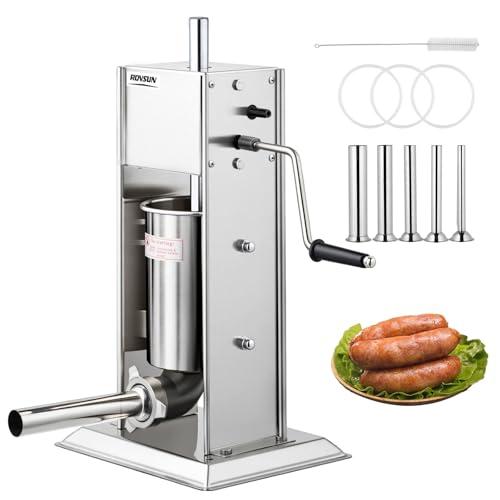
The most machine in the band: a 7 lb stainless cylinder, two filling speeds and five stainless tubes starting at 16 mm. The only sub-$100 stuffer here that publishes a second speed at all.
The most machine in the band: a 7 lb stainless cylinder, two filling speeds and five stainless tubes starting at 16 mm. The only sub-$100 stuffer here that publishes a second speed at all.
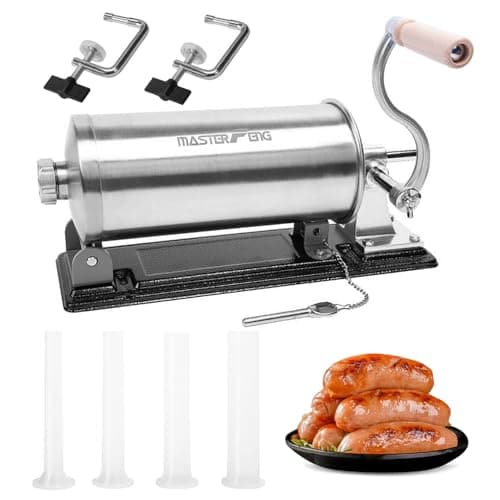
Two G-clamps in the box, an air-release silicone piston and a 6 lb stainless cylinder. The clamps are the reason to pick it over the suction-base horizontals.
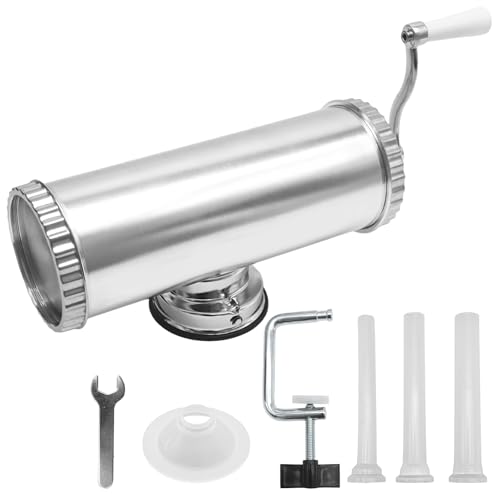
A 5 lb stainless cylinder and a 10 mm tube for about the price of a box of casings. The suction base is the compromise - it needs a smooth counter to hold.
#ad · Prices come live from Amazon, last checked November 20, 2026; where we have no verified live price we show none. Scores are ours on a published 8.4-9.8 scale, compiled from manufacturer specs, manuals and warranty terms — see how we pick. Tap a row for the full write-up.
The best sausage stuffer under $100 is the ROVSUN 7 lb (3 L) vertical. It is the only machine we found inside the cap that publishes two filling speeds, it has the largest cylinder in the band at 7 pounds, and its five stuffing tubes are stainless and start at 16 mm — small enough for snack sticks in sheep or collagen casings, which most stuffers at this price cannot do.
If you want a horizontal, take the Master Feng 6 lb — it is the only one in the band that puts two G-clamps in the box, and a clamped stuffer is a stuffer that stays put. If you want to spend the least, the Vkinman 5 lb horizontal is a stainless cylinder with a 10 mm tube for about what a box of casings costs.
Four machines, ranked on what their makers publish. There is a lot they do not publish, and the honest version of this page spends as much time on that as on the rankings.
The short answer
Under $100 you are buying a cylinder, a piston, a crank and some tubes, all of which are visible in the photographs, and a gearbox, which is not. Every one of these four is a stainless cylinder on a metal frame with usable tubes. None of them tells you what the gears are made of, what the gear ratio is, or how long the maker will stand behind it.
That is not a reason to avoid the band. It is a reason to buy for capacity and tube size, which you can verify, and to stop pretending you are choosing on durability, which you cannot. If durability is the thing you care most about, the honest answer is that it starts just above this cap — see the full stuffer rankings, where the machines that publish gear material and warranty terms are ranked against each other.
The spec nobody in this band publishes
A manual sausage stuffer is a gearbox with a piston on the end of it. You turn a crank, a gear train multiplies the torque, and a piston pushes forcemeat down a tube at a pressure high enough to fill a casing without tearing it. The gears take the whole load. When a cheap stuffer fails, it is almost always a stripped gear tooth, not a bent frame or a leaking cylinder.
So gear material is the spec that should decide this purchase, and in this band it is absent. We read all four listings in full. Not one of them states a gear material, a gear ratio or a warranty term. Compare that with what makers publish immediately above the cap: LEM states reinforced nylon gears on its $100-plus beginner stuffer and a one-year warranty, and metal gears with longer terms further up the range. The information exists at a higher price. It is not that these four have bad gears — it is that nobody will tell you.
What we ranked on instead
Cylinder capacity (25%). Published in pounds or liters on every listing, and the figure that decides how many refills a batch takes.
Gearing (25%). Scored low across the whole band, because nothing is published. The ROVSUN scores highest only because a stated second speed implies a gear train with two ratios rather than one.
Air release (15%). Whether the piston vents trapped air instead of blowing a bubble into the first casing. One of these four states it; the others describe seal rings instead.
Tubes (15%). Diameters, count and material. This is the spec that decides what kinds of sausage the machine can make at all.
Build (10%). Stainless versus plastic in the parts that touch meat, and how the machine mounts.
Value at the live price (10%). Read from the price pipeline at the last refresh and shown on the button, never typed here.
These are the hub's standing stuffer weights — see how we pick. We did not re-weight them to flatter a cheap field.
Cylinder size, in pounds of batch
Cylinder capacity is the one number in this band that translates directly into time at the bench. A batch of snack sticks or summer sausage is normally sized by the seasoning kit, and the common kits on this site make 20 pounds at a time. Divide that by the cylinder and you have your refill count:
Stuffer
Cylinder
Refills for a 20 lb batch
ROVSUN 3 L vertical
7 lb
About 3
Master Feng 6 lb horizontal
6 lb
About 4
Vkinman 5 lb horizontal
5 lb
4
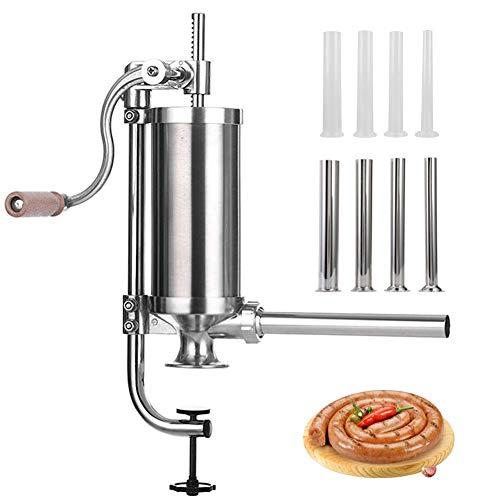
Master Feng 2.5 lb vertical
2.5 lb
8
A refill is not just time. Every time you open a cylinder you warm the forcemeat, and warm forcemeat smears rather than stuffs — the fat starts to break out of the mix. The whole reason to want a bigger cylinder at this price is that it keeps the meat cold by keeping it in the machine. Eight refills on a 20-pound batch is a genuinely worse sausage, not just a longer afternoon.
If your batches are two pounds of fresh breakfast links on a Saturday, none of this applies and the cheapest machine here is the right machine. The batch sizes behind these numbers come from the kits ranked on best snack stick kits and best sausage making kits.
Tube diameter decides what you can make
The second thing published across the whole band is tube diameter, and it is a harder constraint than capacity: a cylinder too small costs you time, but a tube too fat means a kind of sausage you simply cannot make.
Snack sticks want roughly 16 to 21 mm, in sheep or collagen casings. Only the ROVSUN (16 mm) and the Vkinman (10 mm) publish a tube that small.
Fresh links and bratwurst want about 32 to 35 mm, for natural hog casings. Every machine here covers that, except that Master Feng does not publish the diameters on the 2.5 lb vertical at all — it states eight tubes and leaves the sizes unlisted.
Summer sausage and salami use fibrous casings 1.5 to 2.5 inches across and are stuffed through the widest tube you have. The ROVSUN's 38 mm is the largest in the band.
Casing-to-tube matching is the single most common beginner mistake in home sausage making, and it is worth reading before you buy rather than after: the sausage casings guide covers which casing goes with which sausage, and best sausage casings ranks the casings themselves by how much they stuff per pack. If snack sticks are specifically the plan, the tube question is the whole decision and it is worked through on best sausage stuffers for snack sticks.
Mounting: the thing people regret
A manual stuffer needs to resist the force you are applying to the crank, and in this band there are three approaches, which are not equally good.
G-clamps are the best of them, and the Master Feng 6 lb horizontal is the only machine here that includes two. A clamped stuffer does not move, which means both of your hands are free for the casing rather than one of them holding the machine down.
A suction base is what the Vkinman uses, and it works on a smooth, clean, non-porous counter and nowhere else. On a butcher block, a tiled bench, a stainless table with a seam or a counter with crumbs on it, a suction base lets go, usually at the moment the piston is under load. If your processing surface is any of those, treat this as the deciding spec rather than a footnote.
A non-slip foot is what the two verticals have, and on a vertical machine it matters less, because you are pushing down rather than sideways and the force goes into the bench instead of across it. This is the quiet structural reason verticals are more forgiving at low prices, and it is the broader argument on vertical vs horizontal sausage stuffer.
The cheaper option if you own a grinder
There is an option under $100 that is not a stuffer at all, and we would be doing the reader a disservice not to name it on this page: if you already own an electric grinder, a set of stainless stuffing tubes for it costs a fraction of any machine here. The grinder has a motor and a gearbox already paid for, and the tubes bolt onto the head where the plate goes. Add a dedicated snack-stick tube and it reaches sizes most cheap stuffers cannot.
We are not going to pretend that is as good. Stuffing through a grinder pushes the forcemeat past the auger a second time, which smears fat and can give you a pasty texture in the finished link, and you cannot control the rate the way a crank lets you. The site's standing position, argued in full on sausage stuffer vs grinder attachment, is that a dedicated stuffer makes better sausage and that the attachment is the right answer for someone making a few pounds a year or testing whether they enjoy it at all.
Said plainly: if you are not sure you will stick with sausage making, buy $20 of tubes before you buy a $90 machine. If you know you will, buy the machine.
What the next $50 to $90 buys
It buys the information. That is the honest summary of what sits immediately above this cap, and it is worth knowing what you are declining.
LEM's entry-level 5 lb stuffer publishes reinforced nylon gears, an air-release piston, a removable stainless cylinder and a one-year warranty — and LEM also states, on its own product page, that the machine is not intended for snack sticks. That last line is worth more than any feature on it. A maker that tells you what its machine is not for is a maker whose other claims you can weigh. Further up, the MightyBite 5 lb adds published metal gearing. Nothing in the sub-$100 band gives you any of that to weigh.
So the decision at the $100 line is not really about the machines. It is: do you want a bigger cylinder and more tubes for your money, or do you want a smaller machine whose maker will tell you what is inside it and stand behind it for a year? Both are defensible. For a household stuffing a couple of deer worth of trim into fresh links and snack sticks, we would take the cylinder and the tubes, which is why the ROVSUN leads this page. For someone who intends to make sausage every month for a decade, the money is better spent one band up — the beginner-friendly machines are ranked on best sausage stuffers for beginners, and the full field, cap-free, is on best sausage stuffers.
The most machine in the band: a 7 lb stainless cylinder, two filling speeds and five stainless tubes starting at 16 mm. The only sub-$100 stuffer here that publishes a second speed at all.
Rubric inputs — criteria out of 10, weighted into the score above
Capacity fit to season tier
7 · 25%
Gear system (metal gears, 2-speed)
5 · 25%
Air release + removable cylinder
6 · 15%
Tube range incl. snack-stick size
8.5 · 15%
Build
6.5 · 10%
Value
9.5 · 10%
What it gets right
+Two filling speeds, which nothing else under $100 here publishes
+A 16 mm tube, small enough for snack sticks in sheep or collagen casings
+Stainless tubes rather than the plastic funnels usual at this price
Good to know
−Gear material and gear ratio are not published anywhere on the listing
−No stated warranty term
−No air-release piston claim; the listing describes silicone seal rings instead
Skip this if…
…you stuff more than a couple of deer a season — a two-speed metal-geared stuffer like the LEM MightyBite 5 lb publishes what this one does not, and it is the part that wears
#ad · Price as of November 20, 2026 · Affiliate disclosure for the link to ROVSUN 7 lb (3 L) Two-Speed Vertical Sausage Stuffer
2
Best horizontal
Master Feng 6 lb Horizontal Sausage Stuffer
9.1 /10
Two G-clamps in the box, an air-release silicone piston and a 6 lb stainless cylinder. The clamps are the reason to pick it over the suction-base horizontals.
#ad · Price as of November 20, 2026 · Affiliate disclosure for the link to Master Feng 6 lb Horizontal Sausage Stuffer
3
Cheapest real stuffer
Vkinman 5 lb Horizontal Sausage Stuffer
8.9 /10
A 5 lb stainless cylinder and a 10 mm tube for about the price of a box of casings. The suction base is the compromise - it needs a smooth counter to hold.
Rubric inputs — criteria out of 10, weighted into the score above
Capacity fit to season tier
4.5 · 25%
Gear system (metal gears, 2-speed)
4.5 · 25%
Air release + removable cylinder
5 · 15%
Tube range incl. snack-stick size
7 · 15%
Build
6 · 10%
Value
9 · 10%
What it gets right
+Eight tubes, the widest selection under $100 on this page
+Stainless body and a vertical layout at the lowest vertical price here
+Light enough to store in a kitchen drawer between batches
Good to know
−2.5 lb is the smallest cylinder here: a 20 lb snack-stick batch is eight refills
−Tube diameters are not published, so snack-stick size is not guaranteed
−No speeds, gearing, piston or warranty detail on the listing
Skip this if…
…you make snack sticks or summer sausage in 10-20 lb batches — refilling a 2.5 lb cylinder is the whole job, and the ROVSUN 3 L holds nearly three times as much
#ad · Price as of November 20, 2026 · Affiliate disclosure for the link to Master Feng 2.5 lb Vertical Sausage Stuffer (MF-3002C)
How to choose inside the band
Start with the smallest sausage you intend to make. Snack sticks need a tube around 16 mm or smaller, and that eliminates half this band outright. Fresh links and brats need 32 to 35 mm, which everything here can do. Buy the tube before you buy the cylinder.
Then size the cylinder to your kit. A 20 lb seasoning kit is three refills on a 7 lb cylinder and eight on a 2.5 lb one, and every refill warms the meat. If you only ever do two-pound Saturday batches, ignore this entirely and buy the cheapest machine with the right tube.
Then look hard at your counter. Smooth, flat and clean, and a suction base is fine. Anything else, and you want the clamped horizontal or a vertical with a non-slip foot.
Then accept the unknown. No machine in this band publishes its gear material or a warranty term. Work cold, work soft, and do not force the crank, and a sub-$100 stuffer will do a lot more seasons than its price suggests. Force it once with a dry mix and it will not.
What you still need to buy
A stuffer is one item in a sequence, and on a $100 budget it is worth knowing the rest of the list before you spend it all on the machine. You need casings sized to your tubes, cure if anything will be smoked or dried rather than cooked fresh, and a thermometer you trust, because sausage safety is a temperature question and nothing else.
If the whole bench is being built rather than one machine bought, the 1-2 deer setup spends a budget in the order that matters. The stuffer is not first in that order.
The most machine in the band: a 7 lb stainless cylinder, two filling speeds and five stainless tubes starting at 16 mm. The only sub-$100 stuffer here that publishes a second speed at all.
Two G-clamps in the box, an air-release silicone piston and a 6 lb stainless cylinder. The clamps are the reason to pick it over the suction-base horizontals.
#ad · Price as of November 20, 2026 · Affiliate disclosure for the link to Master Feng 6 lb Horizontal Sausage Stuffer
How we picked
Every pick, scored on the same published rubric
Each machine here is read end to end: the maker's spec sheet, the owner's manual and the warranty terms. We pull out the figures that decide whether it keeps up with your season — size number, motor rating, rated pounds per minute, capacity, duty cycle, gearing — confirm parts are still available, and score every pick on the same weighted rubric, so a score on one page means the same thing on the next. Then we show the season math, pounds per deer from the Ohio Division of Wildlife's yield study, so you can run it against your own freezer.
The ROVSUN 7 lb (3 L) vertical. It has the largest cylinder in the band, it is the only sub-$100 stuffer we found that publishes two filling speeds, and its five stainless tubes run from 16 to 38 mm, which covers snack sticks through summer sausage.
Is a sausage stuffer under $100 worth buying?+
Yes, for fresh links and small batches. What you give up is information rather than function: no listing in this band publishes a gear material, a gear ratio or a warranty term, and gears are what fail on a cheap stuffer. Work with cold, slightly wet forcemeat and never force the crank.
Can you make snack sticks with a cheap sausage stuffer?+
Only if it has a small enough tube. Snack sticks need roughly 16 to 21 mm for sheep or collagen casings, and most sub-$100 stuffers ship 19 mm and up. In this band the ROVSUN (16 mm) and the Vkinman (10 mm) publish a tube that small.
Vertical or horizontal under $100?+
Vertical, slightly, because a vertical machine pushes its load down into the bench rather than sideways across it, which matters when the mounting hardware is a non-slip foot or a suction cup. The exception is a horizontal that includes G-clamps, which beats both.
Should I just use my meat grinder's stuffing tube instead?+
If you are making a few pounds a year, or still deciding whether you enjoy sausage making, yes — a set of stainless tubes for a grinder you already own costs a fraction of any machine here. A dedicated stuffer makes better sausage, because stuffing through a grinder pushes the forcemeat past the auger a second time and smears the fat.
How big a cylinder do I need?+
Size it to your seasoning kit. The common kits make 20 pounds, which is about three refills on a 7 lb cylinder and eight on a 2.5 lb one. Refills are not just slow — each one warms the forcemeat, and warm forcemeat smears instead of stuffing.
Specs come from the maker's own pages, manuals and maker-supplied listing copy (labeled as such); food-safety figures from USDA and university extension publications; yield from the Ohio Division of Wildlife; prices live from Amazon. Where a figure isn't published, we say so. Read the full method.