Three hundred dollars is the line where a chamber machine first appears, and that changes the whole decision. Below it you are choosing between seals-in-a-row and wet-meat handling; at the top of it you can stop choosing.
The only machine in the band whose maker publishes a consecutive-seal figure: 250+ seals over up to 2.5 hours, with a pulse function and a built-in roll cutter.
The only machine in the band whose maker publishes a consecutive-seal figure: 250+ seals over up to 2.5 hours, with a pulse function and a built-in roll cutter.
Built for over 100 continuous seals and carrying a two-year warranty, at the bottom of the band. Six modes including a moist setting and both pulse types.
#ad · Prices come live from Amazon, last checked November 19, 2026; where we have no verified live price we show none. Scores are ours on a published 8.4-9.8 scale, compiled from manufacturer specs, manuals and warranty terms — see how we pick. Tap a row for the full write-up.
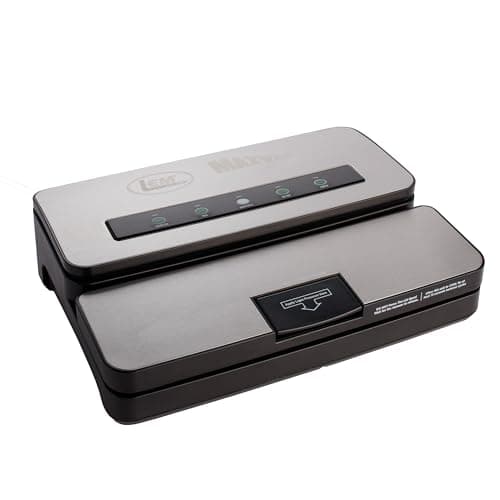
The best vacuum sealer under $300 is the LEM MaxVac 250. It is the only machine in this band whose maker publishes a consecutive-seal rating — 250+ seals over as much as two and a half hours — and that single published number is worth more on a processing day than any feature on the box. It takes bags up to 11 inches wide, has a pulse function for soft trim and a roll holder and cutter in the lid.
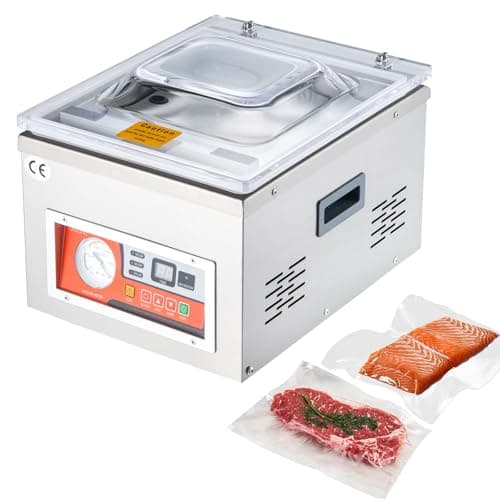
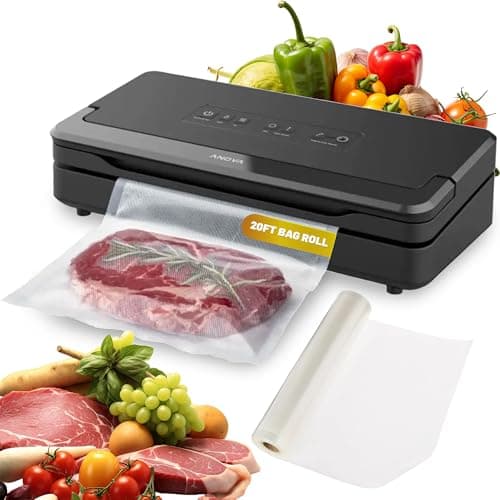
If your packages are wet, take the VEVOR DZ-260A instead. It is a true chamber machine and it sits inside $300 at the top of the band, which is the genuine surprise of this price point: chamber sealing used to start at twice this. If you want to spend the least, the Anova Precision Pro is built for over 100 continuous seals and carries a two-year warranty at the bottom of the band.
Six machines, ranked on what their makers actually publish. Every figure below is the maker's own number from the product page or manual cited under Sources.
What $300 actually buys
Under $100 you are buying a sealer that works and not much else. Between $100 and $300 the money goes to four specific things, and it is worth knowing which of them you are paying for:
A published duty cycle. How many seals the maker will stand behind in a row. Most sealers in this band publish a rest interval instead, which tells you the opposite thing.
Wet-meat handling. A moisture mode, a drip tray, or — at the very top of the band — a chamber, which removes the problem instead of managing it.
Bag width and roll handling. Eleven inches is the practical ceiling in this band. A built-in roll holder and cutter is what lets you size a bag to a backstrap.
Warranty. It runs from one year to five across these six, which is a wider spread than the prices are.
What $300 does not buy is a 15-inch seal bar. That is a dry-aging and whole-subprimal requirement and it lives above this band — see the best vacuum sealer for dry aging if that is your job.
What we ranked on
Published duty cycle (30%). A stated seals-in-a-row figure beats a stated rest interval, and both beat silence. This is the spec that decides whether a processing day finishes in one sitting.
Wet-meat handling (25%). Fresh venison is wet, and an external sealer pulls liquid toward the seal bar. A moisture mode helps; a chamber makes the question disappear.
Bag width and roll handling (20%). Eleven inches, a holder and a cutter, so one bag can be cut to a backstrap and the next to a pound of burger.
Build and warranty (15%). One to five years across this band.
Value at the live price (10%). Read from the price pipeline at the last refresh and shown on the button, never typed here.
The weights are the same ones the rest of this hub uses — see how we pick.
The chamber machine in the band
This is the finding that makes the $300 line interesting rather than arbitrary. Every other machine here is an external suction sealer: it draws air out through the open mouth of the bag, which means it draws liquid that way too. The VEVOR DZ-260A is a chamber machine, and a chamber works on a different principle — the whole bag sits inside a sealed box, the box is evacuated, and the bag seals while everything is at the same pressure. Liquid has nowhere to travel.
For a hunter that matters more than it sounds. Fresh-cut venison weeps, and the standard external-sealer advice is to tray-freeze packages firm before bagging, cuff the bag mouth and leave headroom. Those are good habits, covered in how to vacuum seal wet meat, but they are workarounds for a machine limitation. A chamber removes the limitation.
The trade is real and should be stated plainly: the VEVOR runs an oil pump, which means changing oil, and its 260 mm seal length and chamber depth cap the size of what fits. It is also the heaviest thing in the band. If you want the chamber class compared on its own terms rather than against externals, that is the best home chamber vacuum sealer; the broader argument is in chamber vs external.
Duty cycle, in deer
A seals-in-a-row figure is abstract until you turn it into packages. At the Ohio Division of Wildlife's measured average of about 52 pounds of venison per deer, one deer packaged into one-pound bags is roughly 52 packages — one seal each if you buy pre-cut bags, two each if you cut them off a roll.
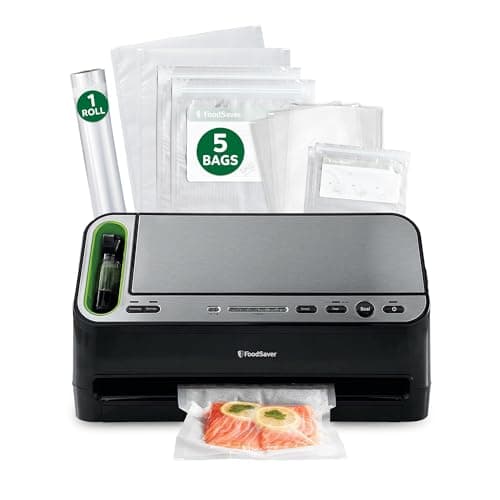
None of this is a criticism of the machines that publish a rest interval; a rest interval is honest information and the FoodSaver's manual is unusually clear about what happens if you ignore it (it shuts off and wants 20 minutes). It is simply the case that a published run figure is the more useful number, and only two machines here give you one. If your season is big enough that this is the deciding spec, the band above is where it is properly solved: the heavy-use rankings cover the machines rated for hundreds of seals.
Wet trim is the other axis
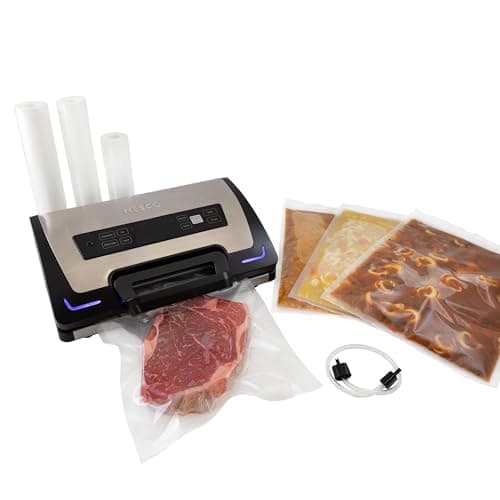
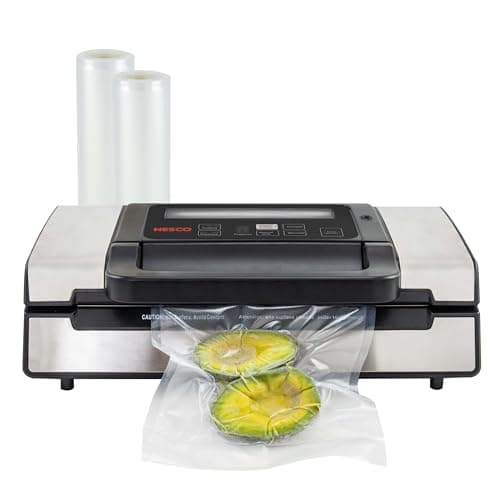
If duty cycle is the first question in this band, moisture is the second, and the two do not have the same answer. The NESCO VS-22LB is the external machine here that takes wet trim most seriously: a dedicated LiquidLock mode, a removable drip tray and a double heat-seal bar. The FoodSaver V4400 detects moisture automatically and chooses the setting for you, which is the right behaviour for someone who does not want to think about it. The MaxVac 250 has a pulse function, which is the manual version of the same idea — you stop the vacuum by hand the moment liquid starts to move.
Whatever you buy, the packaging is only half the job. The USDA's position is that freezing keeps food safe indefinitely and that packaging protects quality — getting the air off the surface is what stops freezer burn. The technique that does that is in how to package deer meat for the freezer, and the format question — rolls or pre-cut bags — changes your seal count by half, which is covered in rolls vs bags.
Seal bar width, the quiet constraint
Bag width is set by the seal bar, and in this band the bar is the spec that quietly decides what you can package. An eleven- or twelve-inch bar takes a bag wide enough for a boned-out venison hindquarter laid flat; a narrower bar means cutting that muscle in two before it goes in, which is a fine outcome for burger and a poor one for a roast you wanted whole.
The chamber machine in this band inverts the problem. A chamber sealer is not limited by bar width in the same way — it is limited by the chamber. Whatever fits inside the box can be sealed; whatever does not, cannot, at any price. For one-pound packages that is irrelevant, and for a long backstrap it is the whole question. Check the chamber's internal dimensions against the longest thing you intend to seal before the bar width persuades you either way.
This is also where the band above separates itself. The wide-bar externals that take a fifteen-inch bag sit past $300, and they exist mostly for subprimals and dry aging rather than for deer — the dry-aging rankings are organised entirely around that measurement. For a season of one-pound packages, bar width is a convenience rather than a constraint, and duty cycle is the spec that will actually interrupt your day.
If your budget is lower
The cheapest machine on this page is well under half the $300 ceiling, so “under $300” is not the same as “spend $300.” Work out which of the four things above you actually need and buy the cheapest machine that has it. A household sealing one deer a year and freezing boneless, trimmed packages does not need a chamber, a five-year warranty or a 250-seal rating, and the money is better spent on bags.
Below this band the decision changes shape again: at that point you are choosing between a sealer and no sealer at all, which is the argument in vacuum sealer vs Ziploc bags. And if the gear budget is the real constraint across the whole bench rather than just this one machine, the 1-2 deer setup spends it in the order that matters. The machine ahead of the sealer in that order is the grinder, and it has its own price band worth knowing — the best meat grinder under $200.
In detail
The picks, in full
1
Best under $300
LEM MaxVac 250 Vacuum Sealer
9.2 /10
The only machine in the band whose maker publishes a consecutive-seal figure: 250+ seals over up to 2.5 hours, with a pulse function and a built-in roll cutter.
#ad · Price as of November 19, 2026 · Affiliate disclosure for the link to VEVOR DZ-260A Chamber Vacuum Sealer
3
Best value
Anova Precision Vacuum Sealer Pro
9.0 /10
Built for over 100 continuous seals and carrying a two-year warranty, at the bottom of the band. Six modes including a moist setting and both pulse types.
Rubric inputs — criteria out of 10, weighted into the score above
Duty cycle (manual)
5.5 · 30%
Wet-meat handling
7.5 · 20%
Bar width / max bag
6.5 · 15%
Bag cost per season
6 · 20%
Build
7 · 15%
What it gets right
+Drops the bag in, detects it and seals without a button press
+Switches to its moist setting on its own when the drip tray sees liquid
+Five-year limited warranty, the longest of any sealer we list
Good to know
−The manual's own troubleshooting page says it overheats and shuts off under heavy use
−Bags top out at the 11-inch roll width
Skip this if…
…you plan to seal a whole deer in one sitting — FoodSaver's manual prescribes a 20-minute cool-down when it overheats, and the LEM MaxVac 250 publishes a rating built for that job
#ad · Price as of November 19, 2026 · Affiliate disclosure for the link to NESCO VS-12 Deluxe Vacuum Sealer
How to choose inside the band
Start with how wet your packages are. If you bag fresh-cut venison straight off the table, buy for moisture: the chamber machine if the budget reaches it, the LiquidLock NESCO if not. If you tray-freeze everything firm first — which costs nothing but a tray and an hour — moisture stops being the deciding spec and you can buy for duty cycle instead.
Then count your packages. One deer is around 52 one-pound bags. Two or three deer in a weekend is where a published run figure earns its money; one deer a year is where it does not.
Then check the warranty against the price. It runs one to five years across these six, and it does not track the price — the longest warranty here is not on the dearest machine.
Finally, budget for bags. They are the recurring half of what a sealer costs, and the format you choose changes your seal count by a factor of two. We work the spend out per deer and per season in what sealer bags cost per season.
What moves a machine out of this band
Two things, and it is worth knowing them before you set a budget. The first is seal bar width: 11 inches is the ceiling here, and whole subprimals and dry-aging bags need more. The second is a published continuous rating in the hundreds, which is a heavy-season spec rather than a budget one.
If neither applies to you, there is nothing above $300 that will make a one-pound package of burger keep better, and the honest recommendation on a $300 page is often to spend less than $300.
The only machine in the band whose maker publishes a consecutive-seal figure: 250+ seals over up to 2.5 hours, with a pulse function and a built-in roll cutter.
#ad · Price as of November 19, 2026 · Affiliate disclosure for the link to VEVOR DZ-260A Chamber Vacuum Sealer
How we picked
Every pick, scored on the same published rubric
Each machine here is read end to end: the maker's spec sheet, the owner's manual and the warranty terms. We pull out the figures that decide whether it keeps up with your season — size number, motor rating, rated pounds per minute, capacity, duty cycle, gearing — confirm parts are still available, and score every pick on the same weighted rubric, so a score on one page means the same thing on the next. Then we show the season math, pounds per deer from the Ohio Division of Wildlife's yield study, so you can run it against your own freezer.
The LEM MaxVac 250. It is the only machine in the band whose maker publishes a consecutive-seal rating — 250+ seals over up to 2.5 hours — and it takes 11-inch bags with a pulse function and a built-in roll cutter.
Can you get a chamber vacuum sealer for under $300?+
Yes. The VEVOR DZ-260A sits inside the band at the top of it, with a 260 mm seal length and an oil pump. A chamber seals liquid without the tray-freezing workarounds an external sealer needs, at the cost of changing pump oil and a chamber that limits package size.
How many bags can a sealer in this band do in a row?+
Only two of the six publish a run figure: the LEM MaxVac 250 at 250+ consecutive seals and the Anova Precision Pro at over 100. The rest publish a rest interval instead — 20 seconds on the FoodSaver, one cycle every two minutes on both NESCOs. At about 52 one-pound packages per deer, that is the difference between finishing in one sitting and spreading it over a day.
Which sealer under $300 is best for wet venison?+
The chamber machine, if the budget reaches it, because liquid cannot travel toward the seal in a chamber. Among the external sealers, the NESCO VS-22LB has a dedicated LiquidLock mode and a removable drip tray, and the FoodSaver V4400 detects moisture and sets itself.
Do I need to spend the full $300?+
No. The cheapest machine here is under half the ceiling and is built for over 100 continuous seals with a two-year warranty. Decide which of duty cycle, moisture handling, bag width and warranty you actually need, then buy the cheapest machine that has it.
What does more than $300 buy?+
A wider seal bar — 14 to 15 inches, which is what whole subprimals and dry-aging bags need — and published continuous ratings in the hundreds. Neither makes a one-pound package of burger keep any better.
Specs come from the maker's own pages, manuals and maker-supplied listing copy (labeled as such); food-safety figures from USDA and university extension publications; yield from the Ohio Division of Wildlife; prices live from Amazon. Where a figure isn't published, we say so. Read the full method.