Smoking ◆ Guide
How to Smoke Venison Jerky on a Pellet Smoker
The method is simple. The thing that trips people up is that most pellet grills will not go low enough to dry, so the order of the steps has to change depending on which machine you own.
We earn a commission if you buy through our links, at no extra cost to you. It never decides the ranking — the method is published · Affiliate disclosure
Venison is close to the ideal jerky meat: naturally lean, so there is little fat to go rancid, and dense enough to slice thin without falling apart. A pellet smoker adds the one thing a dehydrator cannot — real wood smoke — and takes the job outside.
What follows is the method, and one fork in it that depends entirely on your machine.
First: check your smoker's floor
Before anything else, find the lowest temperature your smoker will hold, because it changes the method.
- Floor at or below about 160°F (Pit Boss publishes 130°F on its Navigator vertical cabinets): you can do the whole job in the smoker. Heat step then drying hold, one machine.
- Floor of 180°F (Pit Boss publishes this on its FB2 700 and Carbon 700 horizontals): the smoker cannot do the drying hold. Use it for smoke and the 160°F step, then move the strips to a dehydrator or a low oven to finish.
That second case is not a failure, it is just a two-appliance method, and it makes very good jerky. What does not work is pretending a 180°F floor is a drying temperature and running it for six hours: you get rendered, brittle strips. Which machines publish what is laid out in our pellet smoker rankings for venison and jerky.
Trim and slice
Use a solid, clean muscle — realistically the hams off a whitetail. Trim every scrap of fat and silver skin: fat does not dry, it goes rancid, and silver skin turns to rubber. Be harder about this than feels necessary.
Firm the muscle in the freezer for 30 to 60 minutes before slicing. This is the step that makes even strips possible, and even strips are what makes a batch finish at the same time. Quarter inch is the standard thickness. Slice across the grain for jerky you can bite through, with the grain for the chewy pull-apart kind. Our how to slice meat for jerky guide covers the knife work, and best cuts for jerky covers which muscle to take.
Cure and season
Use a nitrite cure. Jerky spends hours in the temperature range where bacteria are happiest, and a cure is the cheap insurance that covers it. Pre-portioned kits are the simple route because the cure is already measured to the batch weight; if you are mixing your own, the ratio goes by weight and is not a thing to estimate — the curing salt guide explains why.
Marinate in the fridge, not on the counter. Overnight is plenty for quarter-inch strips. Drain and pat the strips dry before they go on the racks: surface moisture is what stops a smoke ring forming and it extends the dry time for no benefit.
The 160°F step
Lay the strips on the racks without overlapping — air has to reach both faces. Run the smoker up and bring the meat to 160°F internal, verified with a thermometer in the thickest strip rather than assumed from the cabinet dial. On a vertical cabinet this is also where the smoke does most of its work, because the meat is still wet enough to take it.
Do not trust the lid probe for this. It reports the air temperature at one point in a cabinet that has real top-to-bottom spread across five or six racks. A separate probe thermometer is the difference between knowing and guessing — see our thermometer rankings.
The drying hold
Now drop the cabinet to its drying range and hold. This is the long part: several hours, depending on thickness, load and humidity. Rotate the racks at least once — the rack nearest the heat source dries faster than the one furthest away, and on a tall cabinet that difference is large enough to finish one rack while another is still wet.
If your machine's floor is 180°F, this is the point where the strips move to a dehydrator or a low oven with the door cracked. They already have their smoke and they have already had their 160°F step; all that is left is water removal, and the appliance that does it does not have to be the one that smoked them.
Knowing when it is done
Jerky is done when a cooled strip bends and cracks but does not snap in half, and shows no wet or shiny spots inside when you tear one open. Test a cooled strip — warm jerky is always more pliable than it will be in ten minutes, and testing hot is how batches end up over-dried.
Over-dry is the easier mistake to make on a smoker than on a dehydrator, because the smoker is working at the top of the drying range rather than the middle. Start checking earlier than you think you need to.
Cooling and storage
Cool the strips completely on a rack before they go anywhere. Bagging warm jerky traps steam, and trapped steam in a sealed bag is how a good batch goes mouldy in a week.
Once cool, vacuum sealing is the best storage there is — with one caveat: a brittle strip will crush before an external sealer finishes its cycle, so use the pulse control if your machine has one, or a chamber machine. We put the actual keeping times, with their sources, in how long homemade jerky lasts, and the format question in rolls vs bags.
Picks for this job
What this method needs
The cabinet that can run the whole job in one machine, the thermometer that tells you the 160°F step actually happened, and a pre-portioned cure so the ratio is not a guess.
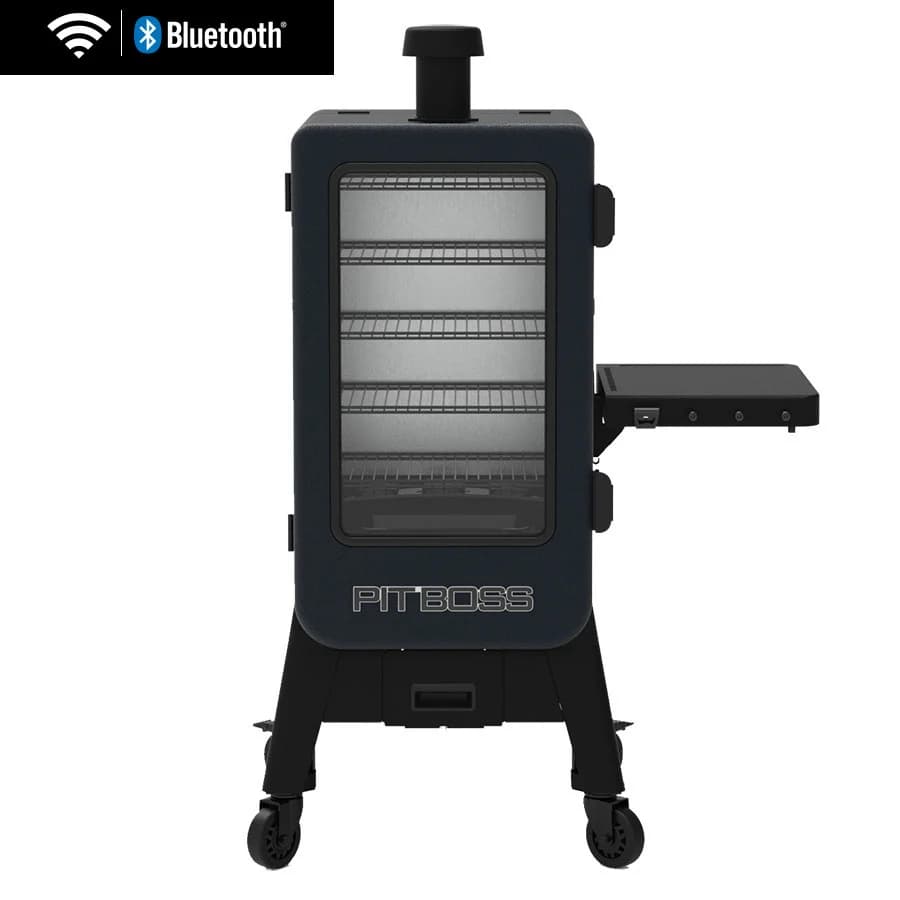
Best for most hunters
Pit Boss Navigator 3-Series Vertical Pellet Smoker (PBV3M)
A published 130-420°F range, so it does both the 160°F step and the drying hold without a second appliance. 1,118 sq in over five racks.
$649.99Pit BossAlso on Amazon#ad · Brand list price as of November 6, 2026 · Affiliate disclosure for the link to Pit Boss Navigator 3-Series Vertical Pellet Smoker (PBV3M)
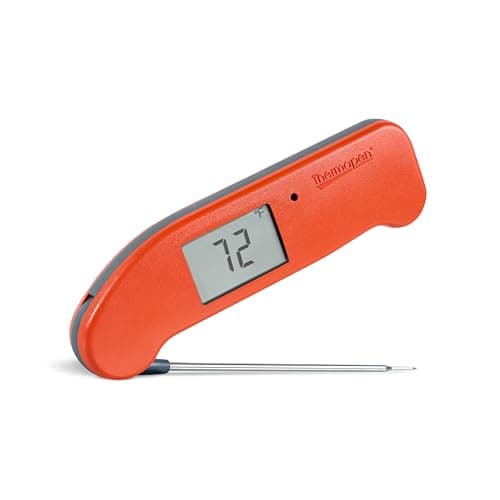
Best thermometer
ThermoWorks Thermapen ONE Instant-Read Thermometer
For verifying the thickest strip hit 160°F. The cabinet dial reports air at one point; this reports the meat.
$125.00ThermoWorks Thermapen ONE#ad · Price as of November 6, 2026 · Affiliate disclosure for the link to ThermoWorks Thermapen ONE Instant-Read Thermometer
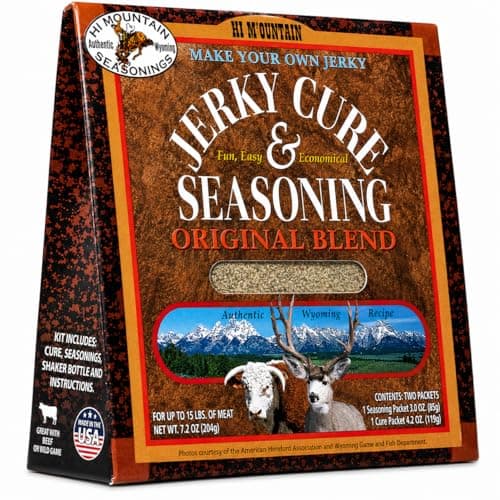
Best kit for beef jerky
Hi Mountain Original Blend Jerky Seasoning and Cure Kit
Pre-portioned cure and seasoning to a stated batch weight, which takes the cure ratio out of the realm of estimation.
$12.49Hi Mountain Original Blend Jerky#ad · Price as of November 6, 2026 · Affiliate disclosure for the link to Hi Mountain Original Blend Jerky Seasoning and Cure Kit
If after all this the smoke is the part you are least attached to, the honest answer is that a dehydrator does the drying better and cheaper — see dehydrator vs smoker for jerky. And if you have not settled on sliced or ground yet, settle that first: ground vs whole muscle jerky decides which gear you need at all.
Questions
Frequently asked
What temperature do you smoke venison jerky at?
How long does venison jerky take on a pellet smoker?
Can you make jerky on a pellet grill that only goes down to 180°F?
Do you need curing salt for smoked venison jerky?
Should you rotate the racks?
Keep going down the chain
Related
Receipts
Sources
- USDA Food Safety and Inspection Service — Jerky and Food Safety
- Ohio Department of Natural Resources, Division of Wildlife — Venison Meat Yield (115 deer, 2017 gun season) [PDF]
- Pit Boss Grills — Navigator 3-Series Vertical Pellet Smoker (PBV3M)
- Pit Boss Grills — FB2 700 Wood Pellet Grill (PB700FB2)
- Pit Boss Grills — Carbon Series 700 Wood Pellet Grill (PB700CP)
Specs come from the maker's own pages, manuals and maker-supplied listing copy (labeled as such); food-safety figures from USDA and university extension publications; yield from the Ohio Division of Wildlife; prices live from Amazon. Where a figure isn't published, we say so. Read the full method.